



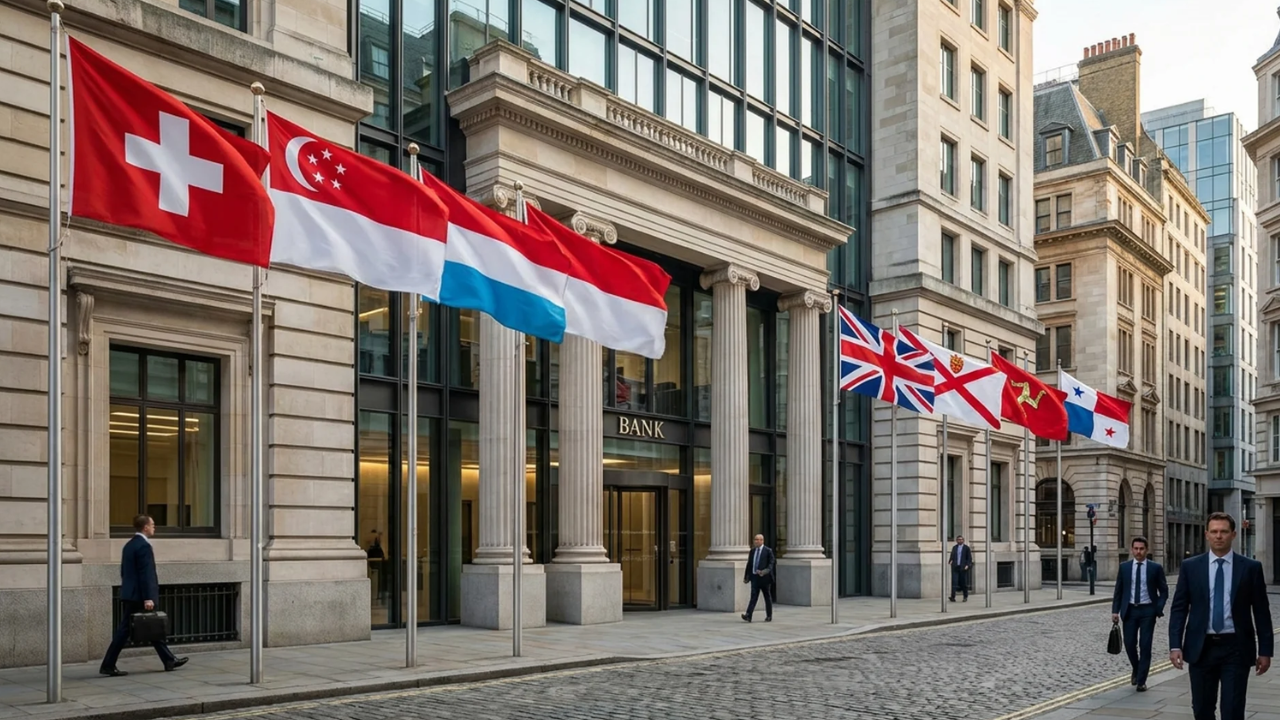
When an entrepreneur evaluates for the first time the idea of opening a bank account in a foreign jurisdiction, they usually talk about “opening an international account”.
In reality two different products exist: premium banking and private banking.
They serve different purposes and have different access thresholds. Understanding the difference is the first step to not opening the wrong account in the wrong jurisdiction, and to not paying commissions that, on significant wealth, are worth thousands of euros per year.
An “international account” is simply a bank account opened in a jurisdiction different from the holder’s residency. The term “offshore” sometimes used to indicate the same instrument has the same neutral meaning, even if collective imagination wrongly associates it with opaque structures.
What changes, once inside, is the category of banking product you open.
For those who want to have capital parked safely in another jurisdiction, operate international transfers and manage the liquidity of an activity with global reach, the right instrument is premium banking.
For those who have significant liquid wealth and want to have it managed or actively manage it in a solid banking context, the right instrument is private banking.
Some jurisdictions offer both, and some institutions accompany the client from one to the other over time. In some cases it makes sense to open a premium account as “operational” and a private one as “investment”, in two different jurisdictions.
Premium banking: when it makes sense, where to open it, how much it costs
Premium banking is the “high” version of the standard current account. It’s not the same as a retail account (salary, current payments, debit card), but it’s not wealth management either: it’s an account designed for those who have availability above a certain threshold and want more structured services than a retail account, without necessarily activating investment services.
The most popular jurisdictions for international premium banking are the United Kingdom, Jersey, Isle of Man, and Switzerland (limited to cantonal banks, because the vast majority of significant Swiss institutions operate under private banking only regime).
The minimum deposit to access premium banking typically hovers around £50,000-100,000 in local currency (pounds, euros, Swiss francs or dollars, depending on the institution).
On commissions, here’s what to expect item by item.
Fee on first deposit. A standard premium institution applies a one-time commission on the first deposit, usually around €500 (in some cases up to €1,000). For clients introduced via GloboBanks this fee is brought down to zero or substantially reduced (in worst cases, from €1,000 it drops to about €150).
Monthly account maintenance. It’s the most recurring item: typically €50-100 per month for a premium account of a certain caliber institution. On this item, an honest note: it’s not a commission our team always manages to zero out in premium. We manage to lower it, but many institutions keep it fixed.
(We’re noticing a positive trend though: several institutions are zeroing it for everyone, regardless of introduction channel, because they realize that even the client with millions of euros has no pleasure in paying €1,000 per year just to keep the account open.)
Commissions on transfers and operations. Here arrives the item that most clients don’t consider at opening time, and which is actually the most impactful. Many institutions apply percentage commissions on transfers and operations even for significant amounts. 0.001% on a €1 million transfer is about ten euros: negligible. 1% on the same transfer is €10,000: significant. The difference between the two commission structures, on important volumes, is the real ROI of banking introduction.
If you have significant liquid wealth and are evaluating an international banking structure, but don’t know if the right category for your profile is premium banking, private banking or a combined setup in multiple jurisdictions, the first step is a free preliminary analysis of the case with the GloboBanks team to clarify before moving any operational step. Schedule it here.

Private banking: when it makes sense, where to open it, how much it costs
Private banking is the “wealth” version of the banking relationship. The private account exists to invest capital. Opening it just to park liquidity is a product matching error: the tariff structure is designed for those who move and make wealth work, not for those who leave it still.
The jurisdictions where international private banking is most developed are Switzerland first, then Singapore, Luxembourg, Principality of Monaco, United Kingdom, Jersey and Isle of Man, and in specific cases Panama.
The minimum deposit varies greatly by institution and jurisdiction. Independently we’re typically talking about:
- €100,000 for “light” private in jurisdictions like Panama
- €1-2 million for mid-level private institutions in Switzerland or Singapore
- €5 million and beyond for top global players in certain jurisdictions
Through banking introduction, the same thresholds are lowered significantly. GloboBanks works with clients starting from €250,000 (with some partner institutions even less), and in significant jurisdictions and institutions accesses conditions that independently would require 5-10 times higher wealth.
On private banking commissions, the difference between independence and introduction is even wider than in premium.
Account maintenance. A high-level private institution typically applies 3,000-5,000 francs (or euros, or dollars) per year for account maintenance. For introduced clients, this item is zeroed in the vast majority of partner institutions.
Wealth management. The standard fee hovers around 1.5%-2% annually. For introduced clients, it’s renegotiated in a typical range of 0.4%-0.8% (in specific cases even 0.3%). On a wealth of €1 million, we’re talking about the difference between €15,000-20,000 per year and €4,000-8,000 per year: every year, for the entire duration of the relationship.
Purchase and sale fees on investments. Critical point that few know before opening: most private institutions apply a commission of €100-200 for each purchase or sale operation of financial instruments. On a regular accumulation plan (for example €50,000 per month in an ETF), we’re talking about €1,200-2,400 per year just to make the operations. For introduced clients these fees are removed.
Fee on parked liquidity. In 95% of partner institutions there’s no commission on uninvested liquidity. If a client deposits €1 million and invests €500,000, the other €500,000 remains in the account without generating any cost.
Currency exchange commissions. Here’s one of the most undervalued advantages. A megabank typically applies 0.5%-1% for currency exchange: on €1 million euros converted to dollars, we’re talking about €5,000-10,000 for a single operation. To give a comparison term: the same operation through a GloboBanks partner private institution usually costs a few hundred euros. They’re orders of magnitude less.
Fintechs like Wise or Revolut are often perceived as the most economical solution for currency exchange, but on the volumes we manage for our clients they apply higher commissions than partner private institutions, in addition to having operational and deposit protection limits that make them unsuitable for the role of main channel.
How jurisdictions combine and multi-account logic
A mature international banking structure rarely lives on a single account in a single country.
An entrepreneur with €1 million of liquid wealth, for example, rarely concentrates it all on a single private account.
The most rational logic for that profile is a distribution: €300,000 in Switzerland for the historical solidity of the system, €300,000 in Singapore for exposure to the Asian banking system (which works in a structurally different way from the European one, and therefore diversifies regulatory risk), €300,000 in a complementary jurisdiction like the Principality of Monaco. Three private accounts opened simultaneously in three different jurisdictions, each with its own intrinsic solidity.
Independently this configuration would require millions of initial deposit for each of the three institutions. The total would be unreachable for some profiles.
Through introduction, the same three accounts can be opened each with €250-300K, total €750K-900K, which is exactly the liquidity the client has available.
An honest note on when private banking doesn’t make sense
If the available deposit is below €200-250K, private banking is usually not the right choice: the numbers don’t add up, and premium banking in a good jurisdiction does the same job at lower costs.
If the objective is “keeping capital parked without moving it”, premium is again more suitable: private banking is built for those who invest, and its tariffs are designed for that relationship model.
And in some specific cases (residency in jurisdictions with high international scrutiny, profiles that the bank doesn’t consider compatible with its own risk profile), not even formal introduction opens the door. In those cases GloboBanks says it before, not after having charged for a service.
Want to understand what’s the right international banking structure for your profile?
The first step is a free preliminary analysis of the case, by phone, with a GloboBanks team consultant. It serves to understand if for your specific profile premium banking, private banking or a combined setup makes sense, in which jurisdictions, even before entering any operational detail.
From that analysis emerge, with concrete details:
- Whether for your profile premium banking, private banking, or a combined setup makes more sense
- In which jurisdictions it makes sense to open accounts, and in which combinations if the setup is multi-country
- The realistic minimum deposit for each of the compatible institutions
- All commissions you’ll actually pay item by item, after negotiation through our channel
- The concrete opening timelines for your residency jurisdiction
Trying independently, especially if the objective is a multi-institution structure, can cost you:
- Required minimum deposits much higher than necessary, which can compromise the entire configuration
- Standard commissions on investment and operations that, year after year, are worth tens of thousands of euros
- Combinations of jurisdictions built “by feeling” instead of based on real solidity criteria
- Months of process with uncertain outcomes, and rejections that remain tracked in the interbank system
Write at this link to book your preliminary analysis.
