




An international marketing agency with revenue of approximately €90 million per year arrived at the GloboBanks team after having paid approximately €270,000 in bank commissions in a single year.
The company’s entire operational flow passed through a single account at a fintech, and the commission applied by that fintech on incoming flows was 0.3%.
On €90 million per year, the arithmetic is simple: €270,000 in commissions every year just to receive client transfers.
This article explains what happened to that company, what we built together to close the outflow, and why operational banking concentration is the least discussed structural risk in banking for entrepreneurs who turn over millions in 2026.
What was really happening: the invisible cost of concentration
The fintech in question was technically doing its job. Transfers arrived, payments went out. The IBAN worked. From the client-bank relationship perspective, there were no visible problems.
What couldn’t be seen was the tariff structure applied to flows of that size. A 0.3% percentage commission on an incoming transfer of €10,000 is a €30 fee: a figure that the average retail account would barely notice. The same commission applied to an annual volume of €90 million becomes a six-figure cost item, which the company’s balance sheet absorbs silently because distributed over hundreds of transactions over 12 months.
To this was added a second problem, less quantifiable but operationally heavier.
The fintech systematically requested justification for every outgoing payment above a certain threshold: transfers to suppliers, team payments, payouts for partner agencies.
And beneath everything, the third risk: the single channel. If for any reason that account had been blocked (a thorough compliance check, a client who gets the transfer reference wrong, an institution policy change) the company would have been left without operability.
No transfers to the team, supplier payments blocked, scheduled ads that collapse. Weeks of paralysis on a six-figure revenue.
Why you get here without realizing it
This situation is not specific to that agency. It can repeat itself in every company that grows organically and gradually.
At the beginning, when the company turns over a few hundred thousand euros per year, a single fintech account seems sufficient. Commissions are visible but small.
Then volumes grow: €1M, €2M, €5M annually. Percentage commissions grow proportionally to revenue, and precisely for this reason don’t seem like a specific problem: “I pay them because I earn, it’s normal”.
When volumes exceed €10-20 million annually, total commissions begin to be five or six figures. At €50-90 million we’re in the hundreds of thousands of euros per year leaving the account without anyone really noticing.
(It’s the boiling frog pattern: the temperature rises so slowly that no one ever notices, until it’s already too late.)
If your company moves significant volumes through a banking infrastructure that wasn’t designed for the numbers you manage today, the first step is a free preliminary analysis of the case with the GloboBanks team: it serves to quantify concretely how much you’re really leaving on the table in commissions and to understand if your current architecture holds your flows. Contact us here to schedule it.
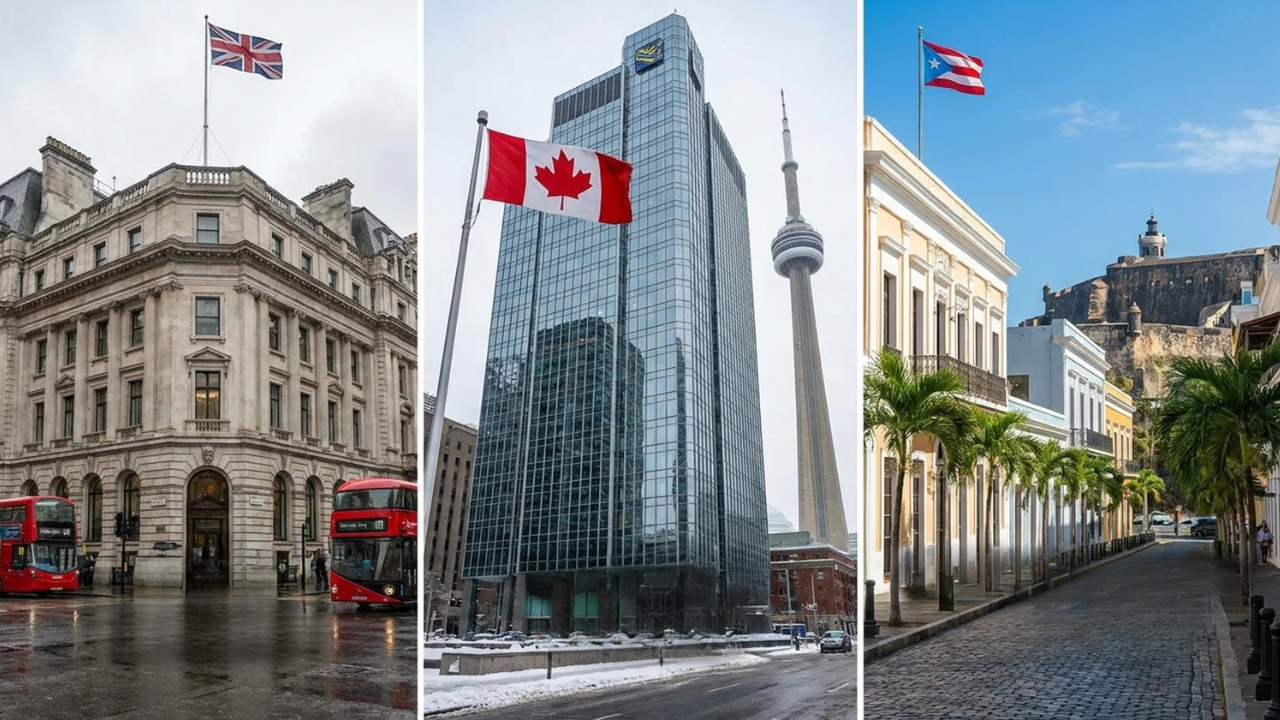
The new architecture built by GloboBanks: two Plan A accounts plus a Plan B backup account
The model applied to the Hong Kong agency is the same we use for every company in that volume bracket. Three precise pieces, each with a specific role.
Two “Plan A” accounts, in two different jurisdictions, used simultaneously. Incoming flows from clients are distributed between the two accounts, typically 50/50. Neither of them ever sees the entire volume. Both are operational and active. If one of the two has a problem, the other continues to function and the company doesn’t stop.
A “Plan B” account in a third jurisdiction, as operational backup. It remains a low-utilization volume account: it serves to cover currencies that the other two banks don’t handle or to provide an exit route if something hits both Plan A accounts simultaneously.
For the Hong Kong agency the configuration was: United Kingdom and Puerto Rico as the two Plan A accounts (both with structured multicurrency, fixed per-transaction commissions rather than percentages, and access to the US banking system through the Puerto Rico jurisdiction, a geographical particularity that most European entrepreneurs don’t consider).
Canada as Plan B for currency market breadth: the Canadian banks we use offer over 150 available currencies, useful for the agency’s clients who paid in less common currencies.
Three different relationship managers, each in a separate jurisdiction. The operational result: zero risk overlap.
A note: this architecture is different from the wealth diversification setup, which is the classic multi-country setup of private banking for HNWIs with parked capital. That concerns where you park personal wealth. This concerns where you run the company’s operational flow. These are two levels that must be kept separate.
The commissions that really change (and those that change little)
Restructuring the operational banking architecture means intervening on specific cost items. Not all of them change in the same way, and it’s useful to know where the real saving lies.
The item that zeroed out in the agency’s case was the percentage commission on incoming flows: from the HK fintech’s 0.3% to the near-zero of the transactional UK, Puerto Rico and Canadian banks (these banks apply fixed per-transfer commissions, not percentages: a €1 million wire costs a few euros instead of €3,000). This single change alone is worth the €270,000 per year.
Alongside the banking restructuring, we also introduced the agency to a European payment gateway with a 1.9% commission on sales instead of the 2.7% applied by the main sector competitors. On a gateway payment volume of a few million per year, the additional saving was approximately 50% of that specific item.
The items that change little or nothing are those of fixed costs: account maintenance, opening fees, monthly costs. Figures in the order of a few hundred euros per year per account, numerically irrelevant compared to the saving on percentages.
The general principle that emerges is that the ROI of an operational banking restructuring lies almost entirely in percentage commissions on volume. That’s where it’s worth negotiating, and that’s where introduction through a structured channel has contractual leverage that the direct client doesn’t have.
Want to understand how much you’re really paying in hidden commissions?
The first step to understand if your company’s banking structure holds the volumes you manage today is a free preliminary analysis of your case, by phone, with a GloboBanks team consultant.
From that analysis emerge, with concrete details:
- How much your current banking infrastructure really costs you per year (often it’s the first time you see the number totalled)
- Which jurisdictions and which institutions are compatible with your company’s profile
- The minimum deposits, timelines and right sequence to migrate without interrupting operability
Staying with the current structure, for a company that moves significant volumes, can cost you:
- Percentage commissions that accumulate year after year and are worth six-figure sums
- An operational block at the worst moment, without a second active account on which to continue invoicing
Write at this link to book your preliminary analysis.
