




The American credit card ecosystem is one of the most powerful in the world. Monthly credit limits far higher than the European average, points programs that on the right spending volumes return thousands of euros per year in travel and hotels. And then access to financial instruments that simply don’t exist in the same format in Europe.
The problem, for those who aren’t residents in the United States, is that this ecosystem is structurally closed.
American banks don’t issue serious credit cards to those who don’t have a US credit score, an EIN number, a physical American bank as reference and an operational connection with the United States that the application can exhibit. And even with all these pieces in place, the order in which you move changes everything: a single sequence error can lower your credit score for months and burn access to premium cards even before requesting them.
This article explains what you really need, in what order, and which cards make sense to target if the goal is to reach the best of the American ecosystem remotely.
Why American credit cards are not like European ones
An American credit card and a European one have the name in common and little else.
In Europe most of what we call “credit card” is actually a deferred debit card or debit card. Contained limits, modest points programs. The card serves to make the purchase, and that’s it.
In the United States the credit card is a different financial product, built around three specific advantages.
Monthly spending power is structurally higher. An entry-level Capital One card issued to a client with low credit score starts from $500-2,000 credit limit, but a Venture X or a personal Amex Platinum can scale to much higher monthly limits, once the credit score has been built correctly.
The points program is where the real economic advantage arrives. A card like the Amex Gold Business returns 4 points per dollar spent on the first $150,000 of annual spending in selected categories (typically advertising, software, some business utilities). On an advertising spend volume of that type we’re talking about 600,000 points, sufficient to cover a dozen intercontinental flights in business class.
And then there’s the third level, that of the ecosystem. Once the relationship with an American issuer is open and the credit score is solid, doors multiply: airport lounges, hotel status levels, cashback on recurring categories, access to reserved products that from outside the system you don’t even see.
The real requirements to obtain an American credit card as a non-resident
The first misunderstanding to clarify is that to access the American ecosystem you don’t need to change residency. You don’t even need to be fiscally connected to the United States in a substantial way. You need a structured operational connection that the application can exhibit as demonstration of establishment.
That connection is composed of four elements.
An active American company. Typically an LLC, single member or multimember. It’s the prerequisite that opens all subsequent steps.
An EIN number issued by the IRS. The EIN is the identification code of the American company, the equivalent of a tax ID in the USA system. It’s requested remotely through a CPA (American accountant), has a contained cost and is issued by the IRS in 6-12 weeks. Without active EIN you don’t proceed.
An American phone number. Specific services exist that assign a real USA number connected to an email or European number. The bank and card issuer verify it, so any VoIP won’t do: you need a number that passes compliance checks.
A current account in a physical American bank. Not a fintech, not a digital service with USA routing number, not Wise or Mercury. A real American bank, with full license, with a relationship manager who can serve as reference for the credit card application. For those starting from the first personal card, usually a personal account is opened in a bank in New York, San Francisco or Miami. For those targeting business cards directly, a business account is opened.
The four elements are concatenated: the American bank doesn’t open without EIN, the EIN isn’t obtained without LLC, and the credit card doesn’t activate without the bank’s relationship manager referencing it.
The right sequence to build credit score (and why most get it wrong)
The American credit score is the number that determines which cards you get approved for, with what limit, and at what conditions. You start from zero when you’re a non-resident without US precedents, and you build it over time through spending behavior that issuers can read.
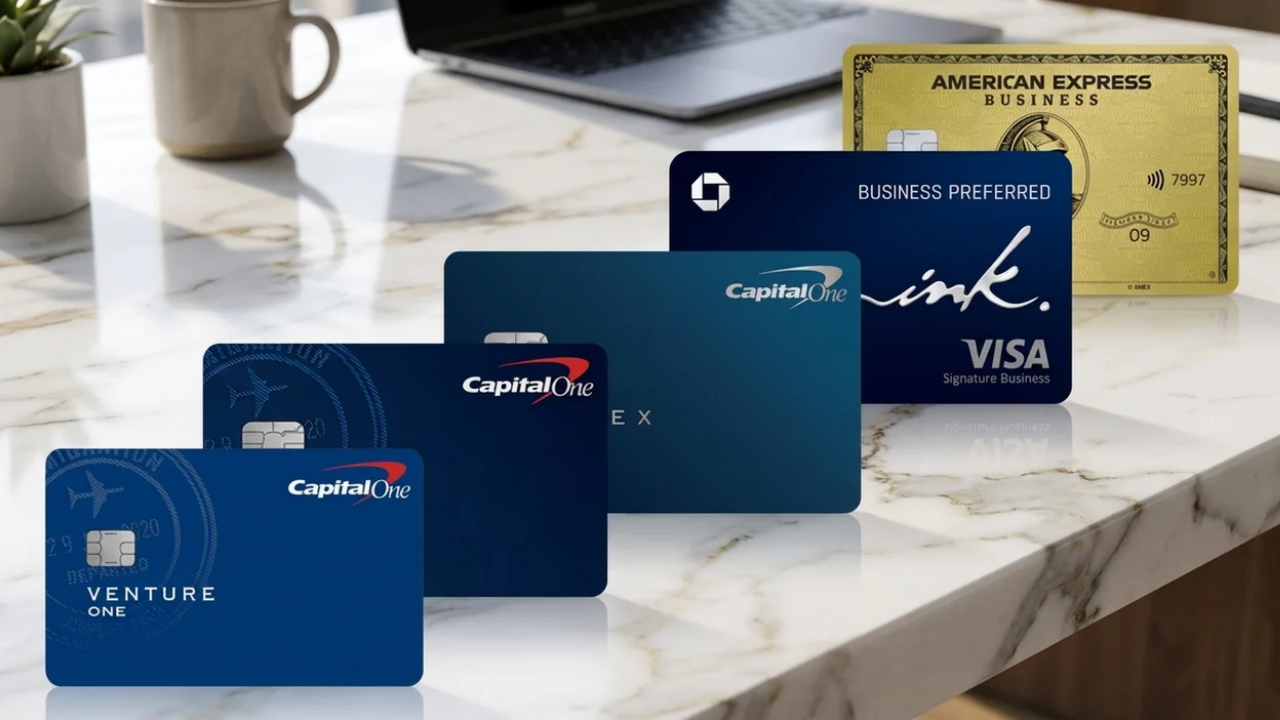
The first card to target, even with credit score equal to zero, is the Capital One Venture One. Typical initial limit between $500 and $2,000, access conditions compatible with a non-resident applicant who arrives with the LLC + EIN + American bank package built correctly.
And here comes the first rule that most DIY applicants ignore: with the Venture One monthly spending must never exceed 20-25% of available limit. On a $1,000 limit we’re talking about a maximum of $250 utilization per month. Spending more signals to issuers a “maxed out” behavior, and the credit score goes down instead of up.
Once the credit score has consolidated (a few months of correct usage), you move to the Capital One Venture. The monthly limit typically rises to $5,000-7,000, and a similar spending rule applies (maximum 30% of limit to not trigger negative signals).
The third step, for those who want to reach the top of the personal ecosystem, is the Capital One Venture X. Annual cost $395, a figure that must be contextualized: the personal Amex Platinum today costs $895 per year (fees have been raised recently).
The Venture X costs less than half and returns 10 points per dollar spent on hotels and travel booked through the Capital One portal, in addition to 2 points per dollar on any evergreen spending.
(This is not a trivial detail: most American premium cards ask for high annual fees and return multipliers only on restricted categories.)
The limit is calibrated on the credit score of the moment, and it’s advisable to arrive at the request with a score of at least 650 to have interesting conditions.
On the business cards side, the two requests that make most sense are the Amex Gold Business ($375-395 per year, 4 points per dollar on the first $150,000 of annual spending in selected categories) and the Chase Ink Business Preferred ($95 per year, 3 points per dollar with similar logic).
To reach these two, the prerequisite is that the credit score connected to the EIN has already been built through the personal path. If instead the business credit score is already solid, in some cases you can skip the intermediate opening and arrive directly at the Ink Business Preferred.
The error that burns credit score in a few days
The EIN number is only one, and all credit card requests (both personal and business) end up connected to the same EIN. So if someone requests a Venture One first, gets approved, and after a month immediately requests a second card (maybe a business card, thinking “anyway it’s another category”) issuers read it as a signal of credit need.
And when an American issuer sees an applicant seeking more credit in little time, it lowers the credit score for protection.
(It’s counterintuitive: it would seem that whoever makes more requests should get more cards, not fewer. But that’s exactly how the American algorithm works.)
It doesn’t give the new card, and simultaneously penalizes the overall position. The damage is double.
The timing between one request and another, how many attempts to make in what time window, which card to request first and which after: it’s the part of the process that requires most experience. And it’s where DIY burns months of work in a few days.
An honest note on what to expect
Even with the process built correctly, some residual rejection arrives. It happens even to the internal GloboBanks team that manages these processes daily: a specific obstacle in a file, a detail that the bank reads restrictively, and the request is rejected. It’s physiological in the American system, where each issuer has its own policies and applies scrutiny that can vary even from week to week.
The difference, when you work with a structured channel, is that an isolated rejection doesn’t translate into a credit score collapse. You recover, reset the application and represent at the right moment.
Those who try independently, instead, typically accumulate more consecutive rejections before understanding the dynamic, and at that point the starting position for subsequent attempts is already compromised.
How the process concretely works with GloboBanks
Initial pre-analysis. A 30-45 minute call in which a team consultant analyzes the profile: current situation (LLC present or to be formed, EIN already requested or not, existing USA bank accounts), final objective (which card or which set of cards you want to reach), realistic timelines.
Setup of missing prerequisites. If LLC, EIN, USA phone number or physical American bank account are not yet active, we evaluate together how to proceed by fixing the missing pieces.
Card request preparation. For each card to request, GloboBanks prepares the application in the format the specific issuer expects, schedules times relative to credit score cycles, and coordinates the reference from the American bank’s relationship manager toward the card issuer.
Credit score growth management over time. Access to premium cards (Venture X, Amex Gold Business, Ink Business Preferred) requires months of correct building, not days. The team accompanies the client along the entire path, signaling when it’s the right moment to request the next card and when instead you need to wait.
Do you want access to the best American credit cards as a non-resident?
The first step is a preliminary analysis of the case, by phone, in which a GloboBanks team consultant evaluates whether your profile is compatible with the path and which set of cards really makes sense to target for your situation, before scheduling any requests to issuers.
From that analysis emerge, with concrete details:
- Which American credit card makes sense to target for your specific profile (not always the most powerful is the best: it depends on your spending volume and the categories on which you spend)
- Which requirements you need to activate to start (LLC, EIN, USA bank, phone number) and which you already have
- The exact sequence of cards to request and realistic times to reach the top of the ecosystem (we’re talking months, not weeks)
- How to avoid sequence errors that burn credit score even before starting
Trying independently can cost you:
- Months spent on rejected applications for format errors that American issuers don’t forgive
- Credit score lowered by the first wrong requests, with cascade effect on subsequent ones
- Annual fees on premium cards that on your profile don’t yield what others could have yielded
- The first positioning window burned, given that rebuilding an American credit score from a compromised position is much slower than building it from zero
Write at this link to book your preliminary analysis.
