



You’ve decided to open a banking relationship with a private bank abroad. Maybe in Switzerland, Singapore or the United States. The first question is almost always the same: where do you even start?
Those who try on their own find out quickly. Emails that go unanswered for weeks, a document that needed notarizing and nobody told you, a second trip to the branch just for a signature. And in the end, often, worse terms than the same bank offers to clients presented by an official intermediary.
In this article we walk you through what really happens, step by step, when an entrepreneur decides to open a banking relationship with GloboBanks: from the first call to an active relationship, usually within two to four weeks and entirely remotely.
(We also talked about this in this video; click here to watch it.)

Why the best banks are in no hurry to take you on
To understand how the process works, you need to start from something few people consider: large private banks don’t need your money.
An institution managing 400 billion in assets doesn’t change its plans for a new client with 10 million. And its model is built on long-term relationships: in Switzerland there are banks that have served the same family for decades, with relationships handed down from father to son. Their goal is to look after the clients they already have, and they accept new ones very selectively.
That’s why those who approach them alone are often filtered out. They ask whether you know someone who is already a client, quote a minimum deposit of 5 million, and invite you to spend three days at their offices “as soon as possible”. It’s simply how they screen people who arrive without references.
The difference between an intermediary and an official introducer
This is where the banking introducer comes in. GloboBanks is not a bank and does not decide whether a banking relationship is opened: KYC, due diligence and approval are always and solely carried out by the bank.
What sets us apart is the kind of relationship we have with the institutions. It isn’t about knowing someone on the inside and sending them an introduction email. With the banks we work with we have a contractual introduction agreement, called a finder agreement: a contract that recognizes us as official partners, authorized to introduce new clients.
Banks also know something else: we are very selective. Before introducing a client, we ask every question the bank would ask, and if the picture isn’t clear we don’t proceed. That selectivity is exactly what gives weight to our introduction.
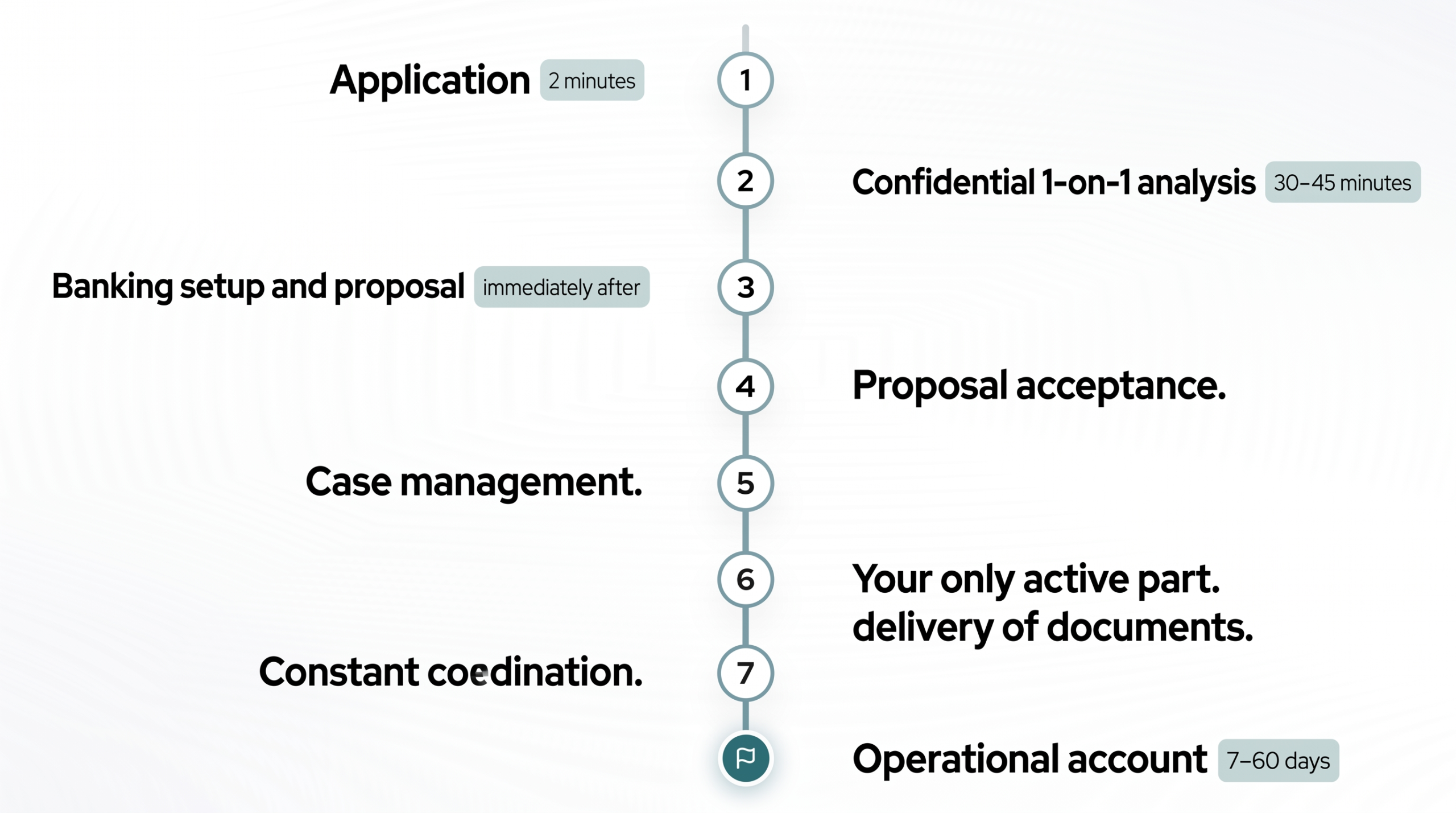
What happens after the first call, step by step
1. Two calls to design your banking setup
We never propose a solution on the first call. Residence is only one piece of the puzzle: the deposit, opening times, the bank’s fees, the type of transactions and the corporate structure all matter.
That’s why the process starts with two calls with a senior manager. The first is for gathering information, the way a doctor would before a diagnosis. In the second you receive a written plan, in black and white, with a banking setup designed around your case: which institutions, in which countries, for what purpose.
If our first questions show that your profile isn’t a fit for our services, we tell you straight away.
2. The service agreement
If you decide to go ahead, you receive a contract that describes the service precisely. One important point: if the chosen institution does not approve your application, the contract provides for an introduction to another institution with equivalent features and benefits.
3. Paperwork, fully handled for you
From here, the client works with their dedicated manager and with the team that handles account openings, people who talk to banks every day and work across Europe, Dubai and the United States in several languages.
Serious banks ask for specific documents: certifications, sworn translations, sometimes notarized and apostilled copies. We take care of all of it: the client doesn’t need to work out which document needs notarizing or where, or send anything in person. Data is handled under very strict confidentiality agreements and kept only for as long as the application requires.
4. Identity verification with the bank
The only step left to the client is KYC, the identity check: the bank needs to know for certain who you are, what you do and where your funds come from. You provide your passport, proof of residence and proof of source of funds, and usually there’s a short introductory video call, about half an hour, with a bank manager, often the deputy director.
No travel, no branch meetings. The law allows the opening to be completed remotely, and the video call replaces the in-person meeting without skipping any checks.
5. An active banking relationship
In most cases the banking relationship is active within two to four weeks, in countries where doing it alone often takes months and a physical visit. For urgent needs, direct channels with the banks can sometimes speed things up further.
If you’d like to see the banking setup we’ve built for clients with a profile similar to yours, the GloboBanks team offers a confidential initial review.
Request your confidential pre-assessment.
Why a serious banking relationship takes weeks (and why that’s a good thing)
A fintech opens an account for you in five minutes from your phone. It looks like an advantage, but it comes with a hidden cost.
No human being can verify a profile in five minutes: an algorithm makes the call. And that same algorithm, built to protect the bank, monitors every move you make afterwards. If you declared an income of 5,000 euros a month and 9,000 come in, the account gets frozen: requests for documents, blocked funds, sometimes the account is closed.
It happens with very large banks too, when the opening was too quick. We’ve seen one of the major international banks freeze a client’s account over a 1,000-pound transfer between two accounts in his own name, in two different countries.
Private banks do the opposite: thorough due diligence at the start, so they don’t need to bother you later. A month of checks, handled by others on your behalf, versus years of surprise reviews. And it makes sense at lower amounts than most people think: from around 100,000 euros upwards, a serious banking relationship is worth having.
Going it alone or through an introduction: what really changes
Fees
A client who had opened a relationship with a Swiss bank on his own, after three trips, was paying around 2,500 Swiss francs a year in maintenance fees. At an even more prestigious Swiss institution, through an introduction, that fee didn’t apply. Over ten years, the difference is 25,000 francs.
The same goes for investment management: where a bank usually charges 1% a year, our terms can bring it down to around 0.3%. On one million, that’s 7,000 euros a year.
Timing
On your own, you’re one of thousands of files on the bank’s desk. For some banking relationships the wait is longer than a year. Through an introduction, it’s a matter of weeks.
Minimum deposit
A bank that publicly asks for 5 million may accept 1 million from an introduced client, because it knows that profile has already been carefully vetted.
Convenience
Extra signatures, a forgotten document that had to be notarized in the bank’s country, another twelve-hour flight. These are the ways banks filter out those who show up alone. With an introduction, the same checks are done remotely. And even after the opening, you’re not treated as just a number.
Frequently asked questions
Can I open a bank account abroad without visiting a branch?
Yes. Where the law allows it, an opening through an introduction can be completed entirely remotely, with a verification video call instead of an in-person meeting.
How long does it take to open a high-end international banking relationship?
Through an introduction, in most cases between two and four weeks. On your own it can take several months.
Does the introducer guarantee the account will be opened?
No. The decision always rests with the bank, which carries out KYC and due diligence independently. The introducer’s job is to prepare a complete profile and present it to the most suitable institution.
Do I need to transfer all my assets straight away?
No. Many clients start by moving a portion, for example 100,000 euros, to assess the service and terms, and then decide whether to move the rest.
How to get started
GloboBanks works with more than 60 banking institutions in over 15 jurisdictions, under formal introduction agreements. Every banking setup draws on the experience we’ve built with clients of very different profiles, and every situation changes something.
If you’ve had an account frozen, want to diversify your wealth or need a banking relationship for your company, the first step is an assessment call with a manager from our team.
Contact the team for your pre-assessment.
GloboBanks provides a banking introduction service. It is not a bank, law firm or tax advisor, and this content is informational, not tax, legal or investment advice. KYC, due diligence and account approval are carried out solely by the bank. Every client is responsible for complying with the tax and reporting obligations of their country of residence.
