



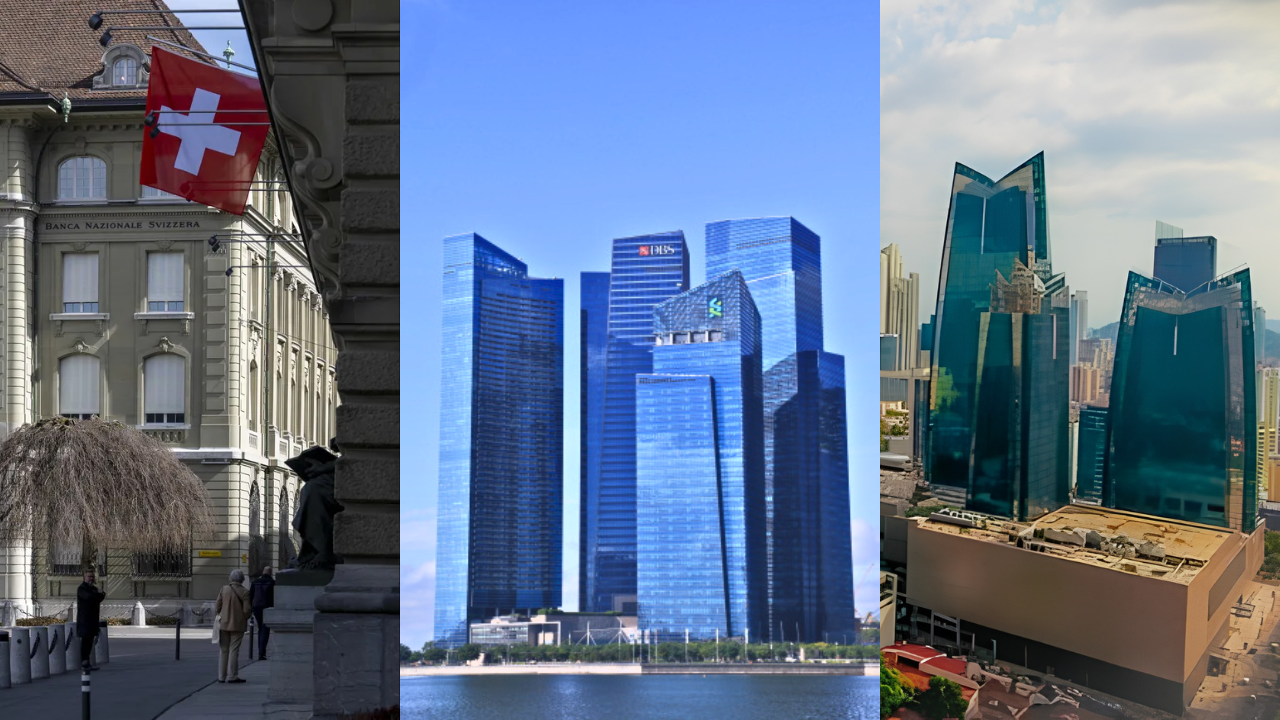
Three jurisdictions dominate the conversation when an entrepreneur evaluates opening an offshore bank account for wealth protection: Switzerland, Singapore and Panama. They are three profoundly different banking systems, built for different client profiles and with different underlying financial products.
Yet in most cases, entrepreneurs arrive at a banking introduction team knowing only that “one of these three is right for them”, without a clear map of what really changes moving from one to another.
This article summarizes the characteristics of the three jurisdictions in 2026, who is in target for each, and why the right answer is often to build a combination that uses the strengths of each rather than choosing just one.
Choosing a jurisdiction comes before choosing a bank
The first misunderstanding to clarify concerns the logical order of decisions. The jurisdiction is the regulatory, fiscal, currency and systemic stability context in which your capital is held. It changes the legal framework that protects deposits and the natural denomination currency. It also changes how the bank is required to behave toward you, and with this the systemic risk associated with that banking system in case of crisis.
The specific bank is the single counterparty within that jurisdiction: important but secondary.
For this reason, before evaluating which institution opens your account, it’s worth understanding which jurisdiction makes sense for your situation.
Switzerland: the standard jurisdiction of global private banking
Switzerland is still today the international reference for private banking. Over 90% of significant Swiss banking institutions operate under private banking regime, meaning structures built not to process daily transfers but to safeguard and grow wealth over the long term.
Three factors converge to make it the reference.
The political and regulatory stability of the Swiss banking system, one of the most solid in the world, capable of navigating financial crises of the last 50 years without major disruption.
Geopolitical neutrality, whereby capital from countries in active conflict with each other coexists in the same system: a structural stability that other jurisdictions cannot replicate.
Who it makes sense for. The classic profile is an individual with liquid wealth between €500,000 and a few million who wants to protect and have capital managed by a solid institution over the long term. The average return on liquid deposits hovers around 3% annually, and access to global financial markets is complete: equities, bonds, ETFs, structured products.
Practical limits. Switzerland is not an operational jurisdiction: private accounts are not designed to handle recurring commercial volumes, and minimum opening deposits independently start from €500,000-1,000,000. By FATCA law, Swiss institutions don’t accept US residents or citizens (with complex exceptions reserved for specific cases).
Average opening times can last months, with physical presence and rigorous due diligence required. Swiss banks are progressively more selective on residencies considered under high international scrutiny (some Middle East jurisdictions, Balkan countries, specific African zones).
Independently vs with GloboBanks. A candidate who presents themselves alone to a typical Swiss private bank today must put €500,000-1,000,000 of initial deposit on the table and wait months of due diligence, almost always requiring physical presence in Switzerland for the identification phase.
Through a structured introduction channel the same institutions are accessible starting from €100,000-250,000 of deposit. Opening happens entirely remotely, with timelines of 30-60 days.
Singapore: the Asian alternative for geographic diversification
Singapore is often defined as “the Switzerland of Asia”, and the definition is not rhetorical.
The Singapore banking system is regulated in an extremely rigorous manner, and the main institutions fall within the “Too Big To Fail” category: banks that, in case of systemic crisis, would be supported by governments and other international institutions to avoid global repercussions.
For an entrepreneur with significant wealth, Singapore is not always the first alternative when thinking about international banking. Yet it has specific characteristics that make it valuable in a multi-jurisdiction setup.
Geographic diversification, through a non-European banking system, is an insurance against the regulatory risk of the EU area. Structured currency coverage on USD, SGD, EUR, GBP, AUD and HKD facilitates the management of international flows in any major currency. And stress test parameters, capital reserves and deposit guarantee mechanisms are governed by Asian frameworks different from European ones: a difference that is precisely the value of diversification.
Who it makes sense for. The target client is the individual with million-level liquid wealth willing to hold it in Asian or American currency, who explicitly wants diversification outside Europe. It’s also the right choice for those who have business relationships with Asian clients and want to receive payments in local currency.
Practical limits. The banking system in Singapore is based on an institutional approach, which differs from the Swiss relationship-based model: banks apply strict compliance controls which, particularly below certain capital thresholds, prioritise soundness and security over personal relationships. The official language of business is English.
Furthermore, Singapore usually requires a concrete link to the jurisdiction (residence, a local company or business relationships) in order to accept new clients, making the system a veritable financial fortress for those without privileged access channels.
Independently vs with GloboBanks. Without a concrete connection with the jurisdiction, Singapore independently is in practice inaccessible to the average international prospect: even demonstrating $1-2 million in wealth it’s not uncommon to receive negative responses or timelines stretching beyond 6 months.
Through a structured introduction channel the main institutions accept non-resident clients starting from $200,000 of deposit, with remote opening possible and contained timelines (approximately 60 days), even without the standard local connection.
If you have significant wealth and are evaluating where to open a private account, or a multi-jurisdiction setup, the first step is a free preliminary analysis of the case with the GloboBanks team: it serves to understand which jurisdiction (or which combination) is realistically compatible with your specific profile before moving any operational step. Contact the GloboBanks office here to schedule it.

Panama: the third option, dollar-denominated and outside the euro-Asian axis
Panama is the least discussed of the three jurisdictions, and this is precisely one of its distinctive traits.
The Panamanian banking system is notoriously solid (no bank in Panama has ever failed over decades of operation), yet it remains off the radar of most high-net-worth individuals thinking about international banking.
Panama is often called “the Switzerland of the Americas”, and for concrete reasons. The US dollar is the country’s current currency: Panamanian accounts are naturally USD-denominated, without the need for conversions or exchange spreads. Geographically Panama is far from areas of European and Asian geopolitical tension, a structural diversification value for those thinking about systemic risk in the long term.
Additionally, some local institutions are natively crypto-friendly, a rare characteristic in traditional banking that opens operational possibilities not available elsewhere.
Who it makes sense for. Panama targets two specific profiles: those who operate commercially with clients in the American area and need a structured USD account in a local jurisdiction, and those who explicitly want to diversify wealth outside the European-Asian axis in a stable but distant jurisdiction. For the international prospect simply seeking standard wealth protection, Panama is typically considered as a component of a multi-jurisdiction setup, not as the sole destination.
Practical limits. Real opening times are generally 30-60 days, but Panamanian banks follow the local calendar which includes extended holiday periods (from November to December many banks operate with 15-20 working days out of 60 total). Due diligence is progressively more stringent, in line with the evolution of international FATF standards. Support is generally in English and Spanish. For most banks with a business account, a verifiable economic connection with the country is required, such as a local company or concrete operations in the American area.
Independently vs with GloboBanks. In Panama the advantage of going through a structured introduction channel shows less on the minimum deposit (which is already relatively accessible for many local institutions) and much more on opening times and file acceptance rate.
A direct application can easily take 3-6 months between local calendar and recurring document requests, and end up rejected for formal details. Through introduction, openings typically close in 15-30 days with a significantly higher acceptance rate.
How to choose (or whether to choose more than one)
For most international HNWIs with liquid wealth between €1 million and €5 million, the answer is to build a combination that uses the strengths of each jurisdiction.
A typical structure for that profile is: a share of wealth in Switzerland for solidity and complete wealth management; a share in Singapore for diversification outside Europe and Asian currency coverage; a share in Panama (for profiles that derive specific benefit from it) for structural diversification outside the euro-Asian axis and native USD denomination.
The minimum deposits for each of the three, through the GloboBanks introduction channel, are significantly lower than public standards.
Considering diversification, on a wealth of €1 million distributed across three accounts, we’re talking about approximately €300K-350K per jurisdiction: perfectly accessible.
Want to understand which jurisdiction (or combination) makes sense for your profile?
The first step to choose with concrete data is a free preliminary analysis of the case, by phone, lasting 30-45 minutes, with a GloboBanks team consultant.
It serves to understand which of the three jurisdictions (or which combination) is realistically compatible with your specific profile, before evaluating which specific institution to open.
From that analysis emerge, with concrete details:
- Which jurisdiction among Switzerland, Singapore and Panama is in target for your situation (and which isn’t, if applicable)
- The realistic minimum deposit per jurisdiction through a structured introduction channel
- The concrete opening timelines for your specific profile
- The right operational sequence in case a multi-jurisdiction setup makes sense (the wrong sequence can compromise the openings)
Trying independently, especially if the objective is a multi-jurisdiction structure, can cost you:
- Minimum deposits required much higher than necessary
- Rejections that remain tracked in the interbank system and worsen your position for subsequent applications
- Months of process with uncertain outcomes, especially in the most selective jurisdictions
Write at this link to book your preliminary analysis.
