



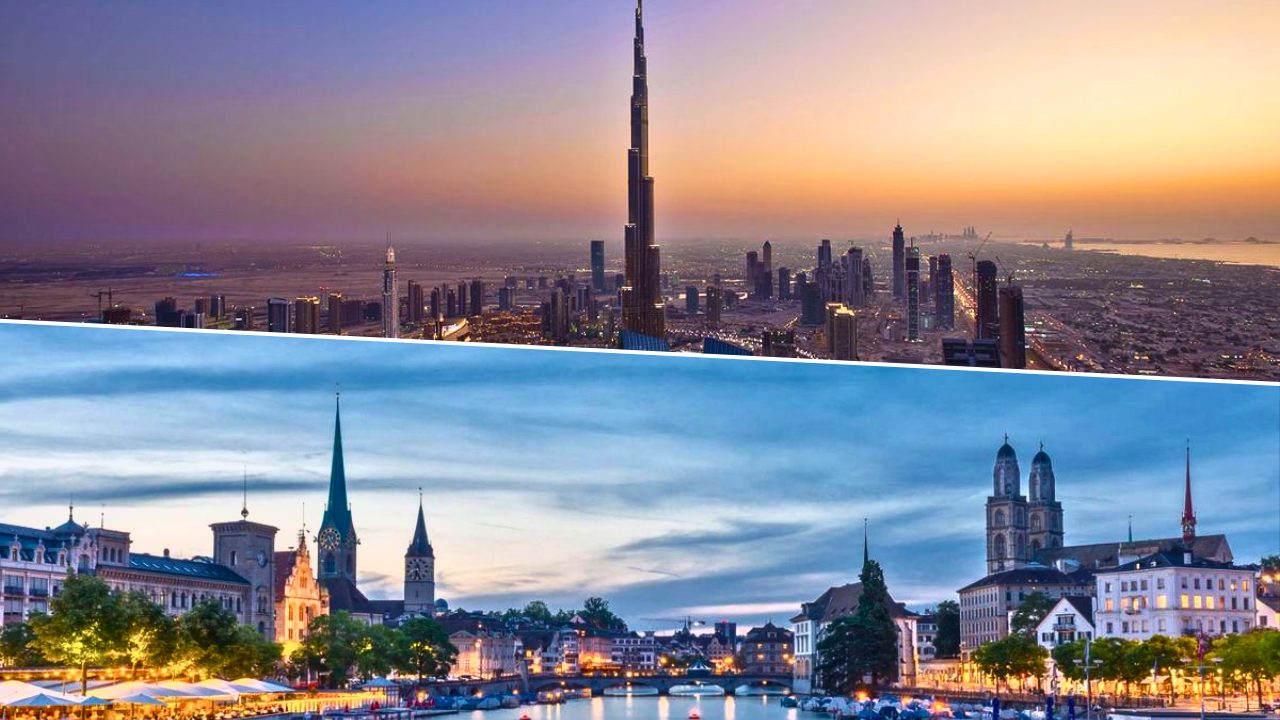
When talking about international wealth protection, the United Arab Emirates and Switzerland are often placed side by side as if they were equivalent alternatives.
They are in reality two models with very different logics, built to respond to different needs.
Confusing their roles is one of the most costly mistakes an entrepreneur can make when structuring their international setup.
Dubai and Abu Dhabi have in recent years become a leading hub for companies, tax residencies and mobile capital.
Switzerland remains the historic and current reference for high-level wealth banking. They are complementary tools, not substitutes.
This article explains how the roles of the two countries have differentiated in 2026, where Dubai really wins and where Switzerland remains irreplaceable, and why an increasing number of international HNWIs are building a combined setup between the two.
Dubai: global hub for corporate structure and tax residency
Over the last five years the United Arab Emirates have built an ecosystem that few other jurisdictions can replicate in the short term.
Free zones dedicated to specific sectors, fast company formation procedures, favorable corporate taxation, absence of personal capital gains taxes for residents. All within an international context where the business language is English, you land from any European hub in 6-7 hours and the logistical infrastructure is of global standard.
According to the Henley Residence Program Index 2026, the UAE rank second globally for HNWI residency attractiveness, alongside Switzerland and Italy.
The Gulf area continues to be one of the markets with the highest net growth of mobile capital.
For the entrepreneur evaluating an international structure, Dubai offers:
- an operational holding in a jurisdiction favorable for corporate tax and simple to maintain
- an effective tax residency accessible in contained timelines
- an international business ecosystem of advisors, family offices and capital networks
- a logistical base globally connected to operate between Europe, Asia and Africa
So far, all correct.
The problem arrives when the entrepreneur assumes that Dubai is also the right place to hold their banking wealth.
Why Dubai is NOT an international banking hub at Swiss level
The Emirati banking system is functional for local operations but has structural limits that those arriving from Europe often underestimate.
The first limit is selectivity.
Opening a bank account in the UAE as a pure non-resident is today more difficult than in recent years: local banks generally require a connection to the country (active residency, operational free zone company, verifiable transaction patterns). From the direct introduction experience of the GloboBanks team, the primary target of Emirati banks remains residents and local companies, not international wealth seeking custody.
The second limit is the wealth management infrastructure.
Swiss-level private banking is built on decades of tradition: relationship with the banker, access to sophisticated financial instruments, generational wealth risk management, culture of continuity.
The main Emirati banks are actively building this capacity, but have not yet reached the depth of consolidated Swiss standards.
The third limit is operational on outgoing flows.
From our team’s direct experience, Emirati banks are generally less flexible on large outgoing international transfers from the country — an aspect that those who opened an account there with the intent to “move liquidity out of Europe” often discover only when they try to move it.
For these reasons Dubai works well as a structure and residency jurisdiction, but is rarely the right choice as the main wealth banking jurisdiction.
If you’re evaluating a combination between corporate structure in the UAE and wealth banking in another jurisdiction, the first step is a preliminary analysis of your case with the GloboBanks team: it serves to understand which architecture makes sense to build for your specific profile before moving any operational step. Contact the office here.

Switzerland remains the wealth banking reference (and in 2026 even more so)
While Dubai grows as a structure and residency hub, Switzerland consolidates its role as the global reference for wealth banking.
The reasons are:
- Private banking maturity.
Over 90% of significant Swiss institutions operate under pure private banking regime, with structures built specifically to safeguard and grow wealth over the long term. It’s a specialization that no other jurisdiction has to the same degree of operational consolidation.
- Geopolitical neutrality.
Swiss banks simultaneously manage capital from clients in countries in active conflict with each other.
This is possible only because Switzerland has maintained a structural position that every party finds useful — an equilibrium that has navigated the main financial crises of recent decades with limited impact.
By contrast, as proven by the geopolitical events of this year, the United Arab Emirates find themselves in a weak position and a theater of conflict.
The combined model that major wealth is adopting
The trend emerging among international HNWIs in 2026 is not “choosing between Dubai and Switzerland”, but combining them in a structured way.
The typical model the GloboBanks team observes working for an entrepreneur with significant wealth includes these two components:
- In the UAE: operational corporate structure, tax residency if consistent with lifestyle, operational base for international business
- In Switzerland: wealth banking through private accounts, long-term capital management, personal and family wealth protection, access to sophisticated financial instruments
For wealth above €5 million a third Asian component (Singapore, in some profiles Hong Kong) makes the setup even more resilient.
According to Reuters, BCG and the main wealth management observers, it’s the model driving the growth of multi-jurisdiction banking in 2026.
Want to understand if a UAE + Switzerland setup is the right choice for your profile?
The first step is a preliminary analysis of the case with a senior manager of the GloboBanks team.
It serves to understand which combination of jurisdictions makes sense for your specific situation, without having to accept either the rhetoric “Dubai is the new Switzerland” or the opposite “only Switzerland works”.
From that analysis you’ll understand:
- whether a combined UAE + Switzerland setup is compatible with your profile, or if a different configuration makes more sense for your case
- which Swiss institutions are realistically accessible for your profile through a structured introduction channel
- the timelines and operational sequence to follow to build the setup without errors (a wrong sequence can compromise openings in both the UAE and Switzerland)
Write at this link to book your preliminary analysis.
