



For over ten years, Dubai has offered large fortunes something money doesn’t usually buy: the peace of mind of no longer having to worry about your own security. Low taxes, flawless services, a city that works. And above all, the feeling that there, whatever happens in the world, your money and your family are safe.
With the tensions that have swept through the Gulf in recent months, that feeling has cracked. The city hasn’t emptied out, yet many entrepreneurs have started asking themselves a question almost no one asked before: does it make sense to keep all your liquidity in the same place where you live?
If you live in Dubai, or hold part of your wealth there, this article walks through the path many of our clients are now choosing. Without relocating and without giving up the convenience of the Emirates, you can move your capital to safety in Switzerland while staying exactly where you are.
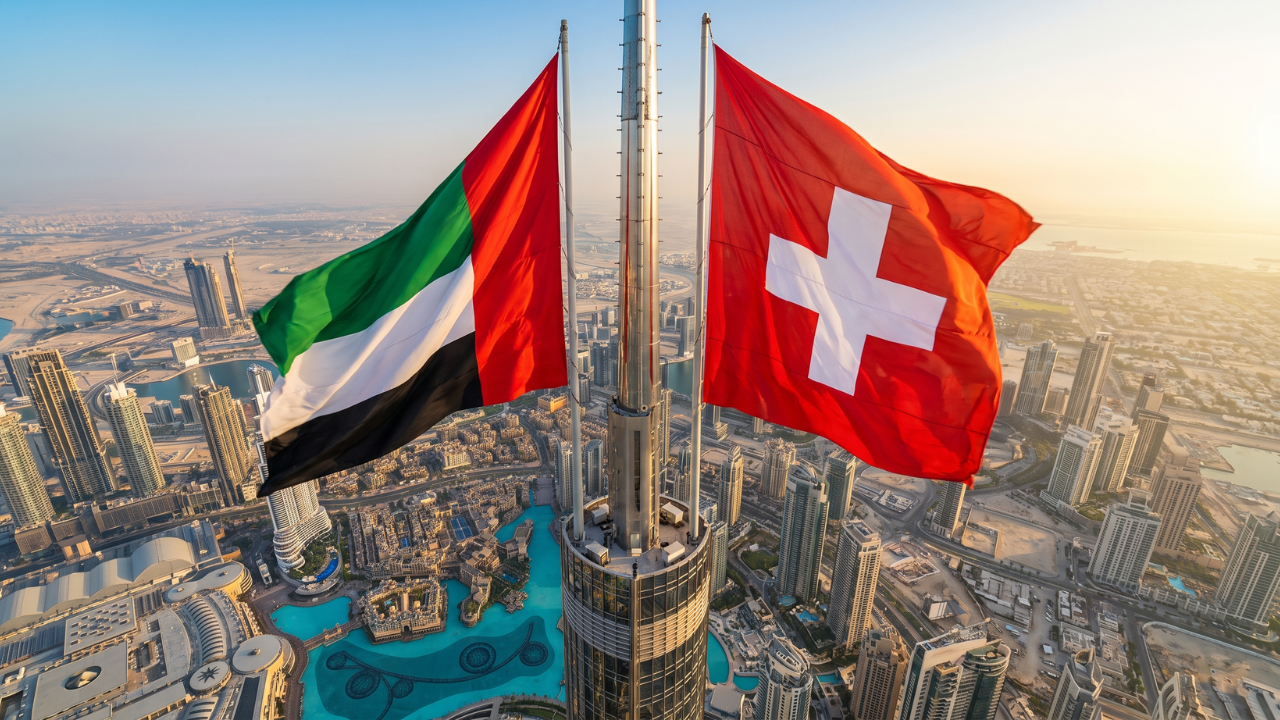
Why Millionaires Chose Dubai
Dubai’s advantage was never just about taxes. There are plenty of low-tax countries, and none of them has attracted capital at the same pace.
The numbers tell the story well. According to Henley & Partners, Dubai is now home to roughly 81,200 resident millionaires, more than double the figure from ten years ago. In 2025, the United Arab Emirates was the world’s top destination for high-net-worth individuals on the move, with an estimated net inflow of 9,800 new millionaires in a single year.
What people relocating there were really buying was one thing above all: the perception of total security. A stable city, far removed from European crises, where business runs smoothly and life flows without friction.
The weak point in this model surfaced precisely when that security was put to the test.
What Changed With the Tensions in the Gulf
When the conflict with Iran hit close to home for the Emirates, the reaction from those managing large fortunes was swift, if quiet.
Swiss private banks received more information requests from clients residing in the Gulf, and several industry players openly spoke of possible inflows worth tens of billions of dollars. Deloitte Switzerland found that liquidity deposited in Switzerland by Emirati clients had already grown by roughly 40% over the previous three years: the movement had started well before the crisis.
In fairness, there was no mass exodus. Many banks described the flows as stable, and most families stayed in Dubai. But the crisis made a risk visible that had previously stayed in the background: when residency, business, and wealth all sit in the same place, a single event can hit all three at once.
And this isn’t a fragility unique to Dubai. It applies to any banking setup built on a single jurisdiction.
If you live in the Emirates and want to understand how to distribute your wealth more solidly, the GloboBanks team offers a confidential initial review of your profile.
Request your confidential pre-analysis.
Where Capital From the Emirates Is Moving
When wealth looks for a more solid harbor, there are few credible destinations. According to BCG’s Global Wealth Report 2026, the world’s top centers for wealth managed on behalf of foreign clients are Switzerland and Hong Kong, each with roughly $2.9 trillion, followed by Singapore with roughly $2.1 trillion. For people living in Dubai, the three choices we see most often are these.
Third Place: The Principality of Monaco
Monaco is the option for those who want their capital in Europe, in a discreet and tightly controlled environment. It’s a more closed and independent hub than Switzerland, with some of the strictest entry checks anywhere. In 2024, the Principality was placed on the FATF grey list, the international anti-money-laundering body, and has been completing reforms to exit it ever since. For anyone opening an account, this means very thorough checks on the source of funds.
It makes the most sense for those with multi-million-dollar wealth, thinking in investment terms, coming from non-European jurisdictions — toward which Monegasque banks are traditionally more open than Swiss ones.
Second Place: Singapore
Singapore offers genuine diversification, on a third continent and far from the Gulf, with one of the most solid banking systems in the world. The real obstacle is getting in: on your own, high-level private accounts often ask for one or two million dollars in deposits. Through our introduction, we’re talking about roughly $200,000, with remote account opening.
For a millionaire-level portfolio, it’s an excellent option, especially if you have business interests in Asia.
First Place: Switzerland
Switzerland remains the benchmark of private banking worldwide. Its banks are built to safeguard and grow wealth over time, across generations. And a relationship with a Swiss private bank has an effect few people consider: it changes how every other bank reads your profile. It’s the strongest banking reference that exists.
Here too, though, independent access is difficult. These banks don’t advertise and prefer a small number of selected, referred clients. Without an introduction, you often need to show up in person in Lugano or Zurich, deposits of one to five million, and maintenance costs running into the thousands of euros a year.
Thanks to introduction agreements with some of the best Swiss private banks, our clients access very different conditions:
- deposits reduced 5 to 10 times, starting from €200,000-500,000;
- maintenance fees waived entirely or cut drastically;
- a relationship manager who speaks your language;
- remote, priority account opening, in roughly 30-45 days.
How to Keep Your Life in Dubai and Your Capital in Switzerland
Now for the strategy promised at the start. Dubai and Switzerland can coexist within the same banking setup, each with a precise role.
You stay resident in Dubai. That’s where you keep the company, the operating account for incoming and outgoing payments, and your day-to-day life, with all the convenience of the Emirates.
The liquidity you don’t need for daily operations, on the other hand, sits at a Swiss private bank. It’s your treasury: you fund it periodically, you don’t use it for everyday expenses, and you put it to work with serious wealth management.
The result is simple. If your local bank runs into a problem tomorrow, if a wire transfer gets stuck under review, or if the region goes through another period of tension, your wealth isn’t there. It’s held at a Swiss institution, under a Swiss regulator.
One useful clarification: some Swiss banks also have branches in other jurisdictions, such as Panama or the Bahamas. These can be excellent solutions, but before opening an account you need to verify where your assets are legally registered. Depending on the structure, two accounts at the same bank can represent real diversification — or none at all.
If you want to go deeper into the logic of the operating account, the backup account, and the private account, we’ve explained it in detail in this article on the three-account structure.
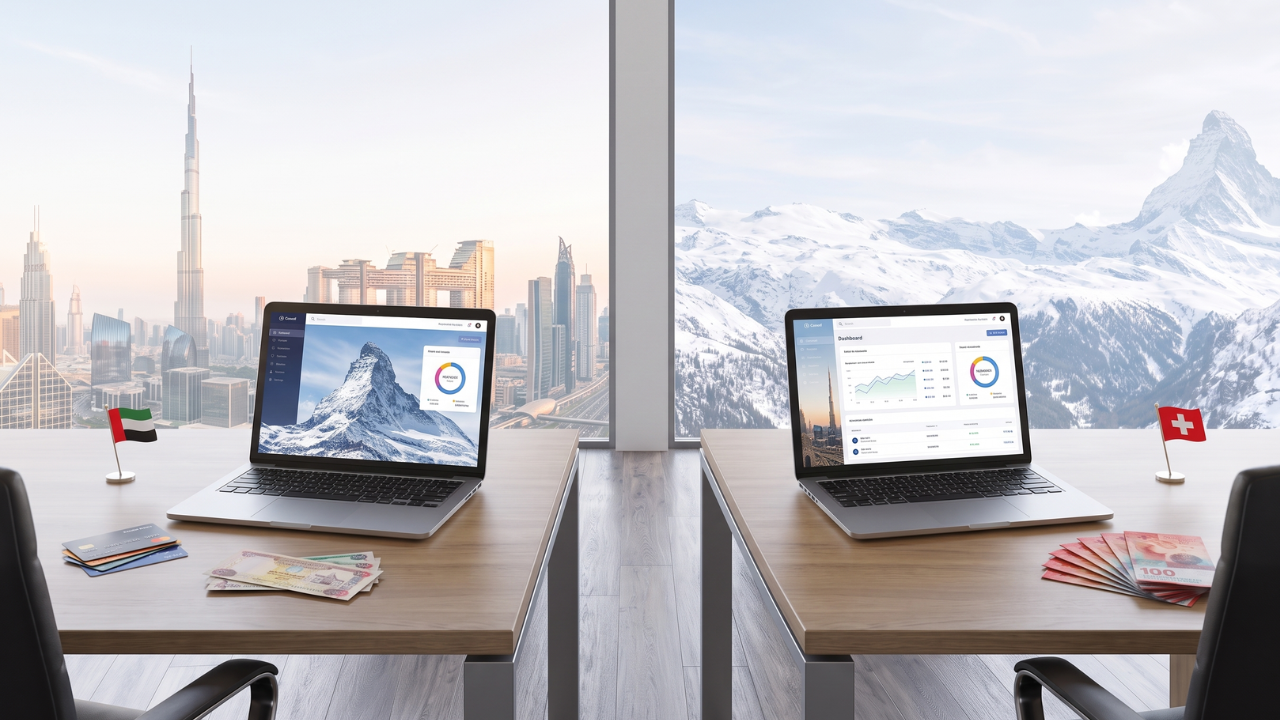
The Most Common Mistake: Thinking About the Bank Last
During the tensest weeks in the Gulf, we kept seeing the same pattern repeat itself. Entrepreneurs planning a full relocation — residency, company, home, and their children’s school — left the bank at the bottom of the list.
Then a wire transfer would get blocked, or an entire flow would end up under review, and they’d find themselves with money sitting in the account that they couldn’t move. At that point, scrambling to find an account in Switzerland, Singapore, or Monaco means running into enormous deposit requirements, months of waiting, and often a rejection, because the best banks are wary of people arriving in an emergency.
The families who handle this phase best think the other way around. No single place is treated as permanent, and no decision is made on a wave of fear. They put residency where it’s convenient, operations where it’s comfortable, and capital where it’s best protected — spread across multiple accounts, never just one.
And above all, they secure their capital first, while things are calm and they can choose with a clear head.
Frequently Asked Questions
Is it legal for a Dubai resident to have a bank account in Switzerland?
Yes, holding accounts in multiple jurisdictions is perfectly legal, as long as the funds are declared according to the rules of your country of tax residency. Swiss banks participate in the automatic exchange of tax information, so this structure is transparent by design: its purpose is to spread risk, not hide it.
Do I need to travel to Switzerland to open the account?
Often, yes, if you go it alone. Through an introduction, in most cases the opening happens entirely remotely.
How much do I need to get started?
It depends on the bank and your profile. Through GloboBanks’ introduction, access to Swiss private banks starts at €200,000-500,000, compared to the one to five million typically required for those who apply on their own.
How to Build Your Banking Setup
GloboBanks works with over 60 banking institutions across more than 15 jurisdictions, and that’s exactly what we do: design the right structure and open doors that would otherwise stay closed on your own.
The right jurisdictions aren’t the same for everyone. They depend on where you reside, where your company operates, and how your money moves. That’s why the first step is always an analysis of your specific case.
If you want to understand which setup makes sense for you, the team offers a confidential initial review, with no commitment.
Contact the team for your pre-analysis.
