



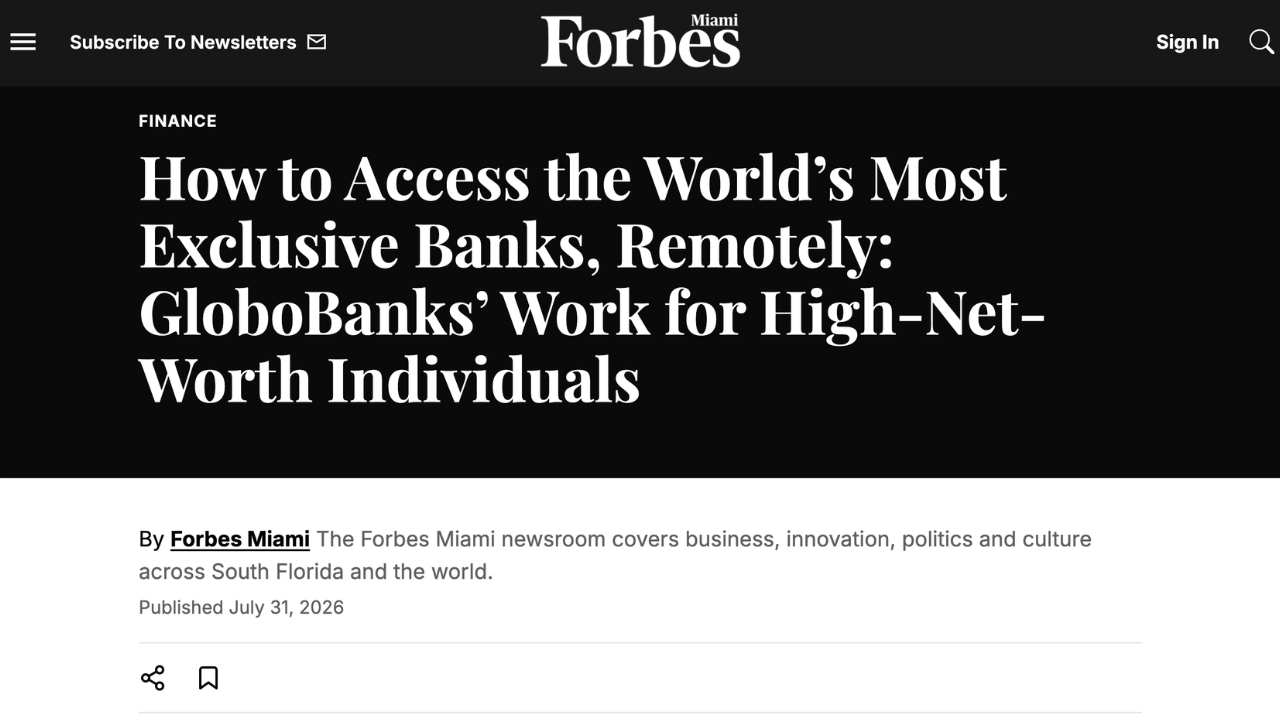
On July 31, 2026, Forbes Miami dedicated an article to GloboBanks and the work we do with entrepreneurs and high-net-worth families.
(The complete Forbes Miami article is available here.)
Beyond being a privilege and an important recognition of the work we carry out, there is a second aspect we consider equally relevant: the fact that publications like Forbes Miami and Investing.com (which had already cited us in the past when discussing banking introduction) are now covering topics that GloboBanks has been addressing with its clients for years.
It’s the signal that these are globally relevant issues, which are finally emerging from industry insiders’ circles.
This article is a summary of those points, with some quotes taken from the interview given by Lorenzo Giberti, founder of GloboBanks.
The paradox of international banking for multi-million dollar net worth
Forbes Miami opens with a paradox that anyone who has crossed a certain wealth threshold should know well.
When the net worth is small or still being built, opening an account is trivial: any app, any local branch welcomes you.
The moment capital grows and truly needs to be protected, the banks built to do so (the high-level ones, holding multi-million dollar capital and billion-dollar companies) become harder to reach.
Although it is commonly believed that large capital is welcome everywhere, elite financial institutions of the caliber of JP Morgan, Citibank and UBS prioritize quality and the client’s profile over the size of the net worth.
For these institutions, the primary objective is to select a clientele aligned with their own operations, laying the groundwork for the development of solid, long-term relationships.
In doing so, most applications are rejected, especially cold applications and those from international entrepreneurs with complex structures.
And what do most of those who are rejected do? They react by doing the most intuitive, and most wrong thing: they turn to the bank around the corner, or to the first result suggested by the internet.
The risks of having only one bank account
The Forbes article clearly addresses a phenomenon that many entrepreneurs tend to regard as an abstract problem: debanking.
Debanking refers to a bank or financial institution that closes a current account or denies access to a financial service to a client, often without giving explanations or advance notice, due to alleged legal or reputational risks.
In the UK market alone, for example, more than a thousand accounts are closed every day. An increase of nearly 7 times compared to a decade ago.
The lesson to learn is that no name, no account, no profile is untouchable.
Those who have a diversified banking structure across multiple accounts, multiple institutions, multiple jurisdictions are not immune, but always have an operational alternative.
What mattered in 1796 still matters today
The heart of the article revolves around a phrase from Lorenzo Giberti, quoted verbatim by Forbes:
“In high-level banking, what mattered in 1796 still matters today: the relationship, the trust, the reference.”
1796 is not a random date.
In those years, in Geneva, merchant-bankers began traveling across Europe carrying letters of introduction: the Baron introduced the Count to his private banker, who personally guaranteed by putting his own reputation on the line in a certified chain of trust.
This is the essence of how the world of private banks still works today.
A high-level bank does not choose a client by reading a form.
A direct application (filling out a form on the bank’s website, sending documents independently, waiting for a response) places the applicant in front of an algorithm in a pile of similar requests.
A formal introduction places the same applicant, with the same wealth profile, in front of a human being whose task is instead to bring in good clients.
Your wealth is a citizen of wherever you keep it
One of the phrases from the Forbes article that summarizes the logic of wealth protection better than any theoretical argument is this: your wealth is a citizen of wherever you put it.
Keeping everything in one country, one currency, one bank means that a single compliance action, by a regulator, by a government, is enough to freeze everything.
The solution is distributing wealth across multiple institutions and jurisdictions so that no decision, anywhere, can freeze the entire operability.
This is how great fortunes have been managed for two centuries.
Banking introduction: access, time and savings
Forbes reports in the article some figures that describe GloboBanks’ work: over 600 accounts opened, more than 250 million euros transited into new accounts, a 97% approval rate for clients who enter the process, across more than 60 institutions in over 15 jurisdictions.
These numbers arise, as Lorenzo Giberti says in the interview, from four years of travel, bank by bank, to build relationships with the directors of the banking institutions we still work with today.
This is how GloboBanks has built contractual and reference relationships with over 60 institutions and continues to expand the network with exactly this logic.
For the client who relies on GloboBanks this translates into time, access and savings.
An entrepreneur in Europe can open an account at a first-tier institution in Singapore or the United States without taking a flight and with a minimum deposit reduced by as much as 10 times.
An American can access a European or Asian private bank, remotely, in significantly shorter timelines compared to the standard path and saving on account maintenance fees.
And this system suits banks too.
With controls from governments and regulatory bodies tightening everywhere, a major institution prefers to receive a pre-verified and introduced client rather than anonymous applications arriving from the website.
Stringent selection is not an obstacle, but the signal that you are dealing with a bank that cares about its reputation and the client’s wellbeing.
The point worth keeping in mind
Beyond the data and individual anecdotes, the Forbes article crystallizes a very simple message: protecting significant wealth doesn’t mean upending your life by changing residency or corporate structure.
It means allocating it in banking institutions and jurisdictions that already adapt to your residency and operations, and this is exactly what you can understand in the first pre-analysis consultation with a GloboBanks manager.
