



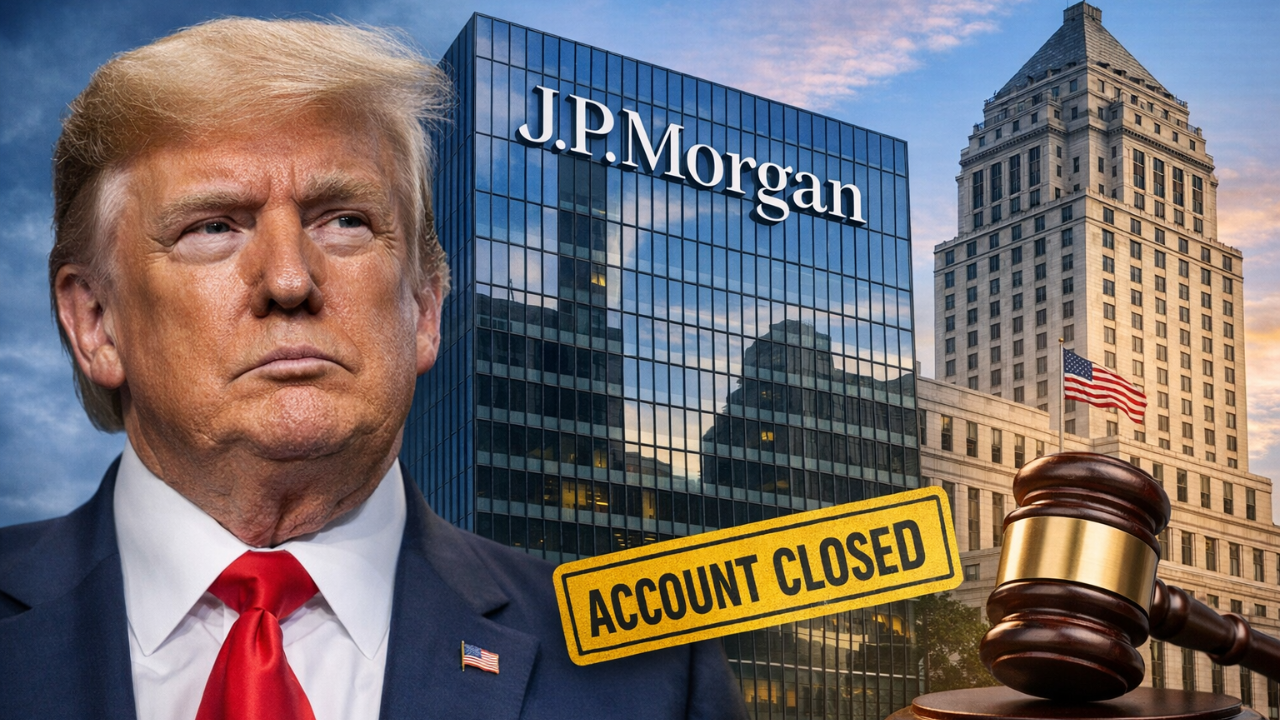
On January 22, 2026, at the Florida state court in Miami, one of the most discussed lawsuits in recent years in the financial world was filed. Donald Trump—the sitting President of the United States—sued JPMorgan Chase and its CEO Jamie Dimon seeking compensation of at least $5 billion.
The central accusation is that of political debanking: according to the complaint, JPMorgan closed over 50 accounts connected to Trump, his family and some of his hospitality companies in February 2021—about seven weeks after the January 6 Capitol assault—not for financial reasons, but for an internal reputational assessment. No insolvency. No financial crime.
Simply the unilateral decision of a banking institution to terminate the relationship with a client deemed, at that moment, “too risky” for the bank’s image.
According to the complaint filed by Trump’s lawyers, JPMorgan allegedly even placed the president, the Trump Organization and members of his family on a reputational blacklist, also shared with other institutions, which would have made opening new accounts elsewhere difficult. The bank allegedly gave about 60 days’ notice without providing explanations considered adequate, forcing Trump’s companies to quickly move their entire operations to other institutions.
This is not an isolated case. A few months earlier, in March 2025, the same Trump organizations had already sued Capital One for the closure of over 300 accounts that occurred in spring 2021, again with motivations linked to “reputational risk” and without sufficient notice.
JPMorgan’s response and Dimon’s statements
JPMorgan responded to the lawsuit claiming that “the bank does not close accounts for political or religious reasons”, but only when they “create legal or regulatory risks for the company”—adding regret, but emphasizing the need to comply with current regulations.
As reported by CNN, the bank also filed a request to transfer the case from state to federal court, arguing that the lawsuit included Dimon “fraudulently,” since a statute explicitly exempts federally regulated bank executives acting in their official role.
Jamie Dimon, in a statement to CNBC in March 2026, used words worth reporting carefully: “The case has no merit. But I understand their position. They have the right to be angry. I would be too. Why should a bank be able to do this?” Also according to CNBC, Dimon added that banks are “forced” to do debanking to comply with regulator pressure, which penalizes them if they manage clients considered risky from a reputational standpoint.
From a legal perspective, experts agree that Trump’s lawsuit has several procedural criticalities. But this is not the most important point.
What is debanking and why is it becoming a global phenomenon
The term debanking indicates the unilateral closure of accounts or limitation of banking services to people or companies that banks consider “too risky”—not for objective financial reasons, but for subjective assessments related to reputation, political opinions, activities carried out or simply the perceived profile of the client.
It’s not a new phenomenon, but it’s growing rapidly and alarmingly.
In the United Kingdom, banks close over 1,000 accounts every working day, with numbers going from less than 50,000 annual closures in 2016 to almost 350,000 in 2022—in many cases without explanations and without effective recourse possibilities.
In Europe, a cross-party group of MEPs submitted a question to the European Commission denouncing the spread of account closures for ideological or reputational reasons, defining them as a concrete threat to the fundamental freedoms of citizens and businesses. The EU responded by announcing a new AML/CFT framework that will come into force in 2027 and will require banks to document and justify every relationship closure. But until then, protections remain limited.
The mechanism that banks use to justify these closures is almost always the same: “reputational risk”.
A deliberately vague category, not precisely defined by any regulation, that leaves institutions broad discretion in deciding who to keep as a client and who to exclude.

What it really means for those with wealth to protect
The Trump affair is the most extreme and visible example of a mechanism that applies every day, silently, to thousands of entrepreneurs, professionals and high-net-worth families around the world.
The logic is simple and brutal: it doesn’t matter how much money you have. It doesn’t matter who you are. If a bank decides that your profile has become “problematic”—for your opinions, for the jurisdiction where you reside, for the sector you operate in, for an internal change in its policies—it can terminate the relationship whenever it wants, with minimal notice and without having to provide detailed explanations.
Trump is the extreme case. But every week there are stories of entrepreneurs with significant wealth, solid businesses and perfectly legal profiles who find themselves in the same situation: account closed, funds blocked, operations paralyzed. Sometimes because of a bank policy change. Sometimes because their residency has become “sensitive”. Sometimes simply because they were introduced into the system the wrong way, with the wrong type of account, at the wrong institution.
Debanking is not a punishment for doing something illegal. It’s the structural risk of those who entrust their financial life to a single institution, in a single jurisdiction, without a banking structure designed to withstand this type of event.
Two concrete lessons to take home
The Trump affair highlights two distinct problems, which require two distinct solutions.
The first concerns how you arrive at the bank. When you enter as a “normal customer” and the bank decides to do reputational cleanup, you have no privileged interlocutor, no direct relationship with management, no one who can manage the situation before it becomes a unilateral closure.
Those who are introduced to a banking institution through a certified introducer—a figure who has direct relationships with the bank’s management, who has already performed their own due diligence on the client, and who vouches for their profile—is perceived by the bank in a radically different way.
They’re not a number in a database. They’re a pre-qualified client, managed by a trusted partner, with whom the bank has an established relationship over time. This changes the perception of risk, and changes how the bank behaves even when things get complicated.
The second problem concerns concentration.
Having all your operations, all your capital, all your financial life in a single bank or in a single jurisdiction means handing over total control of your business to that institution. An internal decision, a reputational assessment, a regulation change: and it’s game over.
Banking and jurisdictional diversification is not a privilege for those with astronomical wealth.
It’s the minimum structure necessary for those who want their wealth to withstand events that don’t depend on them—geopolitics, policy changes, unilateral decisions by institutions. Accounts in different jurisdictions, at institutions that don’t depend on the same regulators, with structures that continue to function even when a single bank changes its mind.
As the Trump affair demonstrates, no wealth and no name is big enough to make you immune. Protection doesn’t come from the size of the account. It comes from the quality of the banking structure you’ve built.
Want to understand if your banking structure would withstand such an event?
GloboBanks works every month with hundreds of entrepreneurs and high-net-worth individuals to build solid international banking relationships, introducing its clients to institutions through direct relationships with management—not by filling out online forms. The business model is based on contracts and relationships with over 60 banks in more than 15 jurisdictions, built over years of work in the field.
This means that when a GloboBanks client enters a bank, they do so with a pre-qualified profile, managed by a partner the bank knows and trusts. A very different position from those who open an account alone—and discover it at the worst possible moment.
During a free consultation with a GloboBanks expert you can concretely understand:
- Whether your current banking structure is adequately diversified by jurisdiction and institution
- Which banks and jurisdictions best fit your residency profile, type of activity and wealth
- How a banking relationship that holds over time is built, even in tension scenarios
- What the practical steps are to open accounts in high-profile jurisdictions, entirely remotely
The consultation is free and without obligations.
→ Book your free consultation with a GloboBanks expert
