



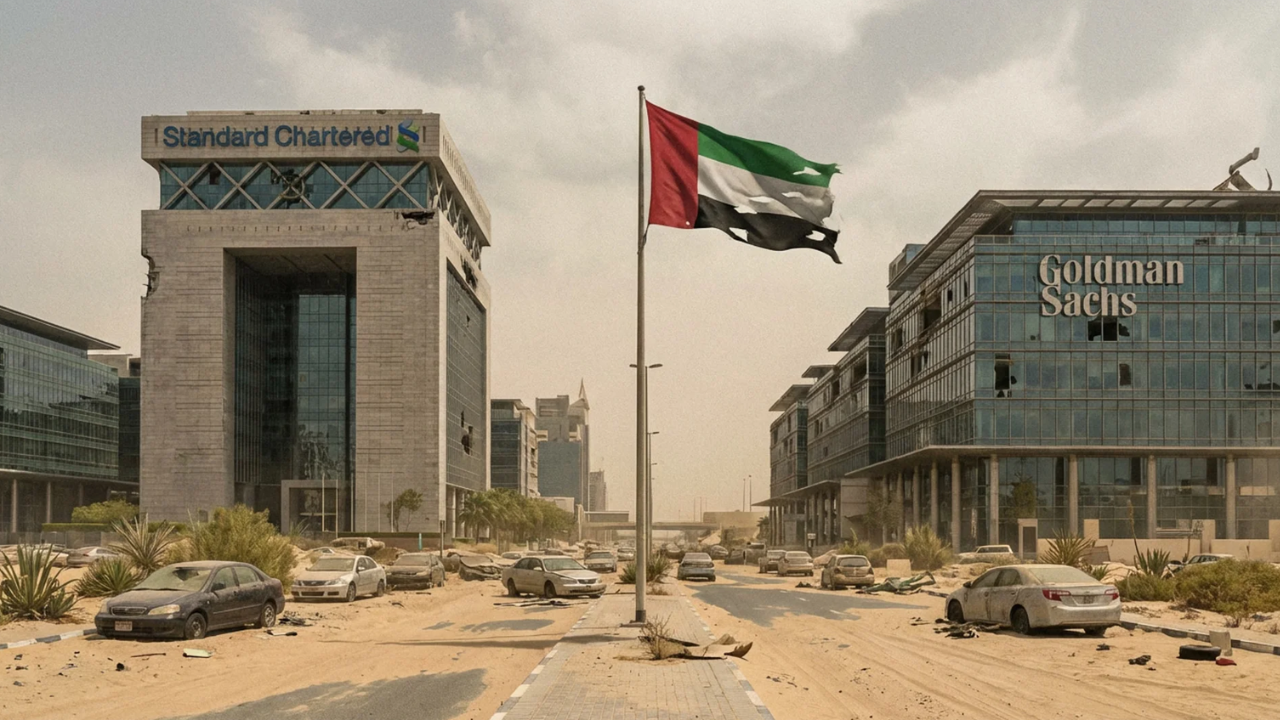
There’s a specific day to mark on your calendar if you have a bank account in the Emirates: February 28, 2026.
That day joint US-Israel raids on Iran rewrote the risk map in the Gulf. Tehran’s response arrived within hours: missiles, drones and, something that had never happened before, the official announcement from the Iranian military command to target banks and financial institutions throughout the Middle East.
Within 48 hours:
- Goldman Sachs imposed on employees the obligation to request authorization before going to the office throughout the region.
- Standard Chartered ordered employees near the Dubai International Financial Centre to leave the offices.
- The three largest Japanese banks (MUFG, Sumitomo Mitsui and Mizuho) initiated formal evacuation of key personnel toward Tokyo or low-risk Asian hubs.
GlobalCapital defined the DIFC a “ghost town,” a phantom financial center.
And this is the context in which your capital is deposited, if you have a bank account in the Emirates.
Dubai is no longer “neutral”: the end of a myth
For years Dubai sold itself as the Switzerland of the Middle East.
Free zone, open economy, political equidistance, physical distance from regional conflicts.
A place where capital was safe regardless of who sat in Washington, Moscow or Beijing.
That positioning worked as long as equidistance was possible.
Now it no longer is.
The Emirates host American military bases. When Iran decided to strike infrastructure linked to the US military presence in the Gulf, the UAE became a target. Period.
The result was immediate and documented: Dubai airport hit, Jebel Ali port in the crosshairs, residential buildings and hotels damaged.
And the American consulate in Dubai attacked, which changed the level of risk perceived by every major institution present in the city.
No other country in the region, except Israel, has suffered a similar concentration of strikes.
For those managing wealth, these are the questions that weigh: if the country’s main port infrastructure is attacked, if the airport suffers interruptions, if major financial institutions evacuate personnel, what happens to deposit liquidity in case of escalation? What happens to international transfers in transit on SWIFT? How do you access the account if the bank managing it moves critical operations out of the country?
These aren’t catastrophist hypotheses. These are the same questions that family offices, hedge funds and corporate treasuries are asking themselves right now.

What major wealth is doing: flows toward Switzerland
In the risk models of large wealth managers, in a few weeks Dubai has slipped from “emerging but stable jurisdiction” to “jurisdiction under active geopolitical stress”.
The consequent movement is already documentable.
Sector estimates speak of tens of billions of euros in transit from the Gulf toward jurisdictions considered structurally safer: Switzerland and Singapore in the lead, with Switzerland absorbing the predominant share of European and Middle Eastern flows.
Swiss private banks are managing a wave of requests above their usual load. Compliance teams are saturated. Waiting times that until a few months ago were 4-6 weeks today exceed 3 months.
There’s something the average prospect doesn’t know, and that’s worth explaining.
When significant wealth moves from Dubai to Geneva or Zurich, the receiving Swiss bank doesn’t just look at the client’s profile. It also looks at where the funds are coming from, what the recent history of that jurisdiction is in international compliance systems, and especially what the political-military context is that motivated the transfer.
A note that weighs more than it seems: the Emirates only exited the FATF (Financial Action Task Force) grey list in February 2024, after years of international pressure for their anti-money laundering system. The current context adds a level of scrutiny that Swiss banks are already applying, increasingly, on every file arriving from the Gulf.
Translated: those who wait become progressively less appealing to Swiss private banks, even with an impeccable individual profile.
The problem no one talks about openly
Swiss private banks work through formal introductions. The client arrives presented by an intermediary with whom the bank already has an established relationship, with a dossier already prepared, through a channel that skips public queues and standard algorithmic screening.
When a client presents themselves directly (online form, email to the portal, cold contact), approval probabilities are low. Especially for non-residents.
And every rejection remains. If Vontobel says no to you, when you arrive at Pictet, they see it. The candidate’s position worsens with each failed attempt.
Those who arrive through a formal introducer like GloboBanks enter a preferential lane, thanks to direct agreements between our team and partner banks, and thanks to the pre-application prepared even before the first contact with the institution. It’s comparable to skipping the line, legally.
If you have capital in the Emirates and are evaluating moving it, the right time is NOW.
Before the windows tighten further, before the jurisdiction of origin becomes more complex to explain, and (this is the critical point) before changing residency.
There’s a precise sequence that applies to everyone, and most prospects get it wrong. As soon as you change residency from the UAE to any destination, this happens.
The UAE bank you’re exiting immediately activates the most aggressive due diligence.
At the same time the Swiss bank you’re entering sees capital arriving from someone who just left an active conflict zone.
Result: both shores become more difficult to cross at the same time.
The right sequence is only one: first you move the capital, then you move yourself.
How to move capital from Dubai safely
You have capital in the Emirates and are evaluating how to move, but don’t know which bank to start with, which ones accept your profile, and what happens operationally if you wait another 3-6 months.
The GloboBanks team does one very specific thing: strategic analysis of the individual dossier, free, in a 30-45 minute call.
At the end of the call you know (with names and numbers):
- Which Swiss institutions are compatible with your specific wealth profile, and which are NOT.
- The alternatives beyond Switzerland that make sense to evaluate for your profile: Singapore, Panama, UK. (Not all three work for everyone. The call serves this purpose too.)
- The real minimum deposits today, not those on the website.
- The concrete opening timelines for those arriving from the Emirates at this moment (not the standard 2024 ones).
- A clear sequence on what to prepare and in which order to move: capital first and residency after.
GloboBanks is an international banking introducer with formal agreements with over 60 banking institutions in Switzerland, Singapore, Panama, UK and USA.
In the last 3 years we’ve opened more than 450 bank accounts and moved over 90 million euros through the structures we’ve built for our clients.
One of the situations we manage most often right now involves entrepreneurs with capital in the Emirates who tried to open a Swiss account independently, received one or more rejections, and contact us when their position is already weaker than it was six months earlier.
