


Investing.com published an article—in which we are cited—on how the world of banking introductions works and why this profession, born three centuries ago, has never been more relevant than today.
The article starts from 1796, when Geneva’s merchant-bankers personally traveled to Paris, Vienna, and London carrying something more precious than gold: letters of introduction from existing clients. This represented the only way to access elite financial services of that era.
Two centuries later, that system is experiencing a renaissance.
The paradox is clear: while wealth has become increasingly mobile thanks to digitalization and globalization, access to the world’s most sought-after and prestigious banking services has become more restricted.
Some examples:
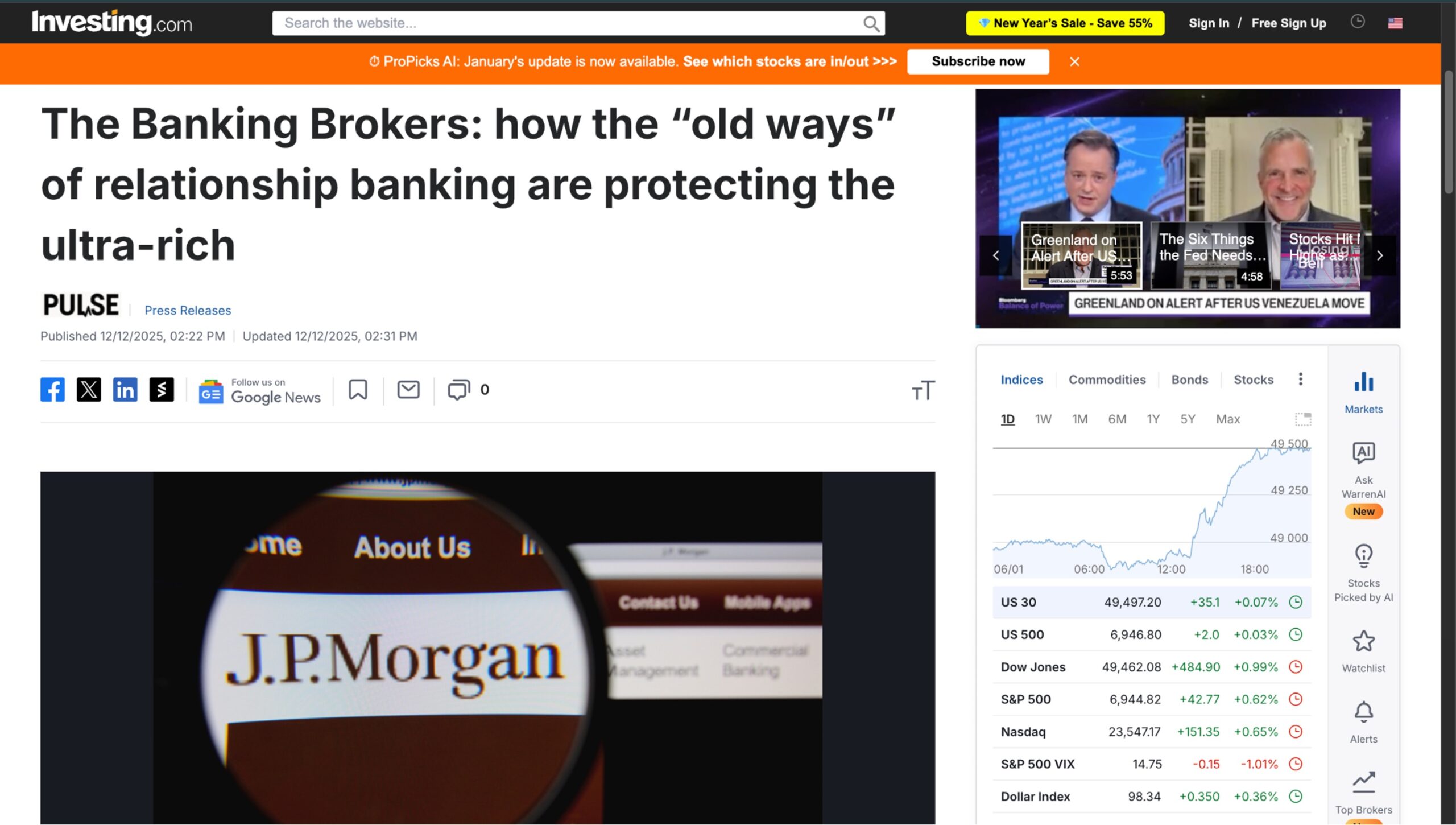
- JP Morgan refused Donald Trump as a client
- In the United Kingdom, over 1,000 accounts are closed every day—a 700% increase since 2017
- In 2021, British banks closed over 343,000 bank accounts, while clients introduced by privileged intermediaries continue to access premium banking services
This growing divide reveals a global banking system operating on parallel tracks: algorithms and reputational risk for the public, personal relationships and multigenerational trust for the ultra-wealthy.
GloboBanks is cited in the Investing.com article as an example of this new era: “We are seeing the re-emergence of a two-tier banking system. One public, algorithmic, and increasingly restrictive. One private, relationship-based, and accessible only through personal introduction.”
From Geneva to the World: The Birth of the Introducer System
The tradition of banking introducers is not a modern invention. In 1713, the Grand Council of Geneva approved the first European banking secrecy regulation, creating the trust framework upon which the entire relationship banking system would be built.
When Henri Hentsch founded what would become Lombard Odier in 1796—while the French Revolution was devastating markets—he had to rebuild from scratch. The solution was a sophisticated two-tier system: at the top operated elite banks that monopolized access to wealthy families, surrounded by a ring of intermediaries competing to bring investment opportunities.
This system, born in a pre-technological era, was based on a simple but powerful principle: trust is more precious than capital itself.
From 1800 to Today: Mass Debanking
Debanking—the unilateral closure of bank accounts without notice or detailed explanations—has become such a widespread phenomenon that Wikipedia has dedicated a specific page to it. This is not about isolated cases or occasional errors, but a systemic trend that is excluding millions of people and businesses from the traditional banking system.
According to Financial Conduct Authority data, British banks closed 45,000 accounts in 2016-17, a figure that exploded to 343,000 in 2021-22—a 729% increase in five years. This means over 1,000 accounts closed every business day.
Victims rarely receive explanations: banks generically cite “concerns about financial crimes” or notify closure without details.
The most emblematic case? Nigel Farage, whose private bank Coutts closed his accounts because his political opinions were deemed “incompatible.” But the phenomenon reached unthinkable heights when Donald Trump publicly declared that JP Morgan would not be willing to open an account for him.
The Financial Ombudsman Service recorded a 69% increase in debanking complaints between 2020/21 and 2023/24. In February 2024, the UK Treasury Committee revealed that eight of the UK’s largest banks closed 140,000 small business accounts in a single year.
Why Banks Prefer Introduced Clients
The answer is simple: efficiency and quality. The numbers are unequivocal.
A Wharton School study that tracked 10,000 customers of a German bank for 33 months found that referred clients have:
- 25% higher value in the short term
- 16% higher Customer Lifetime Value over six years
- 18% lower churn rate
But the real reason banks love introducers? Perceived risk collapses. When a client arrives through a trusted intermediary with whom the bank has an established relationship, the institution already knows that:
- Due diligence has already been done – The introducer has pre-qualified the client
- The profile is reliable – The intermediary’s reputation is at stake
- The client will stay – Retention rates are higher
- Operating costs are lower – Less friction, fewer rejections, less wasted time
Ally Bank revealed that its referral program has 3-4 times higher efficiency than other marketing channels. Brazilian fintech Nubank achieved 80-90% of acquisitions organically through referrals, with marginal costs.
The mechanism is the same that made the Geneva system work in 1796: trust transfers. When a merchant-banker introduced a client to Lombard Odier, he put his own reputation on the line.
Today, when GloboBanks introduces a client to an international bank, the mechanism is identical.
The Two-Speed System: Algorithmic for the Public, Relational for the Privileged
GloboBanks, a company specializing in international banking introductions with over 60 active partnerships, enables remote opening for jurisdictions such as the United States, Switzerland, Singapore, Panama, UAE, and other strategic financial centers.
Lorenzo Giberti, founder of GloboBanks, describes the mechanism: “Without an official introduction, your bank account application risks being waitlisted or completely ignored by banks’ automated systems. With an introducer, the process is simplified: you can open and manage your account remotely, quickly, with complete support.”
Banks have rationalized operations, replacing human judgment with risk assessment algorithms.
But for clients who arrive through privileged channels—modern introducers who perpetuate the tradition of Geneva’s merchant-bankers—there still exists a parallel track where personal relationships, the intermediary’s reputation, and multigenerational trust count more than any automated score.
If you try to open an account with a major international bank on your own, you probably won’t even receive a response.
If instead you are introduced through a banking partner with established relationships, the account can be opened in 4-8 weeks with a completely remote-managed process.

A Return to Origins or the Institutionalization of Privilege?
The contemporary banking system presents a paradox that Lombard Odier’s founders in 1796 would have perfectly understood: trust remains the most precious currency in banking, but today it is distributed increasingly unequally.
For millions of ordinary customers, entrepreneurs, and small businesses, access to banking services has become an obstacle course of algorithms where a single “red flag” can mean permanent exclusion. For the ultra-wealthy and those with the right introductions, 18th-century relationship banking not only survives but offers growing competitive advantages: approval rates over 90%, reduced minimum deposits, simplified procedures, and access to premium services (credit cards, priority assistance, relationship managers who speak your language, and many others depending on the bank).
The question that remains open is not whether this two-speed system exists—the numbers confirm it unequivocally.
The question is whether regulatory authorities, after the Farage and Trump scandals, will intervene to democratize banking access, or whether the “introducer model” will continue to define who can and cannot fully participate in the global financial system.
Why Are Business Foundations Based on Banking Choices?
Simple: without adequate banking infrastructure, any international strategy—whether involving foreign companies, tax planning, or change of residence—means building on fragile foundations.
You can have the world’s best tax planning, but if the bank closes your account after three months, you’re stuck. You can set up a perfectly structured American LLC, but if you can’t open a business account that fully accepts this corporate form, that company is unusable.
That’s why the bank comes before everything—before taxation, before corporate structures, before residencies. And you might discover that getting a perfect banking setup could save you the bureaucracy and, worse, changes of residence and money spent simply to further complicate your situation.
Want to Know How to Access Banking Solutions That Truly Protect Your Capital?
GloboBanks allows you to schedule a free initial 30-minute consultation with an international banking expert to explore which international banking options are available for your specific situation.
👉 Book your free strategic consultation
